12 Best Exercises For Lumbar Strain
Lumbar strain can make even simple movements feel challenging, but the right exercises can help restore mobility, ease muscle tightness, and strengthen your lower back safely. A focused routine that includes gentle stretching and core activation supports faster recovery and reduces the risk of future strain.
Introduction:
A common and often painful injury to the muscles and ligaments of the lower back is a lumbar strain. By performing specific stretches and exercises, you can alleviate back pain and improve the range of motion in the affected muscles.
Supporting and stabilizing the spine requires the use of muscles in the hips, buttocks, abdomen, and lower back. Maintaining the strength and activity of these muscles can help prevent low back injuries and reduce pain in the event of a spinal injury.
The most common cause of back strains is overstretching or tearing the tendons and muscles that support the spine. Sports, physical activity, or another kind of mistake can cause this.
Lumbar strain can be uncomfortable and inconvenient, even though it is a condition that can be properly treated. You can successfully manage the pain, restore function, and develop the strength required to avoid further injuries by staying committed to a systematic and gradual exercise program.
The severity of the injury affects how long it will take to recover from a lower back strain. A minor strain might heal in a few days, but a severe strain or torn muscle will probably take six to eight weeks to heal. Numerous factors, including the type of treatment used, overall health, and the severity of the strain, influence recovery time.
Causes:
Overuse and Repeated Motions
- Bending, lifting, twisting, and pulling are examples of repetitive motions that may strain the lumbar muscles.
- This causes tiny tears in muscle fibers over time, which causes pain and inflammation.
Unexpectedly Strong Lifting
- Excessive strain on the lumbar musculature results from lifting a heavy load improperly.
- The sudden strain of using the back instead of the legs can cause muscles and ligaments to tear or overstretch.
Being overweight
- The lower back is subjected to an additional mechanical load when one is overweight.
- This eventually causes lumbar muscle fatigue and chronic strain.
Unhealthy Sleeping Postures
- Muscle fatigue and morning strain result from sleeping in awkward positions or on a sagging mattress, which keeps the spine out of alignment for hours.
Bad Lifting Techniques
- When lifting, poor posture puts uneven strain on the lower back.
- This makes acute muscle strain more likely.
Unexpected Rise in Physical Activity
- Deconditioned lumbar muscles can be overworked when they begin exercising at the gym or performing strenuous household chores after a prolonged period of inactivity.
Sports-Related Damage
- Sports like football, weightlifting, and tennis that call for quick twisting, jumping, or intense physical contact can strain the lumbar muscles because of high-intensity force and quick movements.
Long-Term Standing or Sitting
- The back muscles become fatigued when sitting for extended periods, especially if you have a rounded spine or inadequate lumbar support.
- As a result, the postural muscles become more prone to strain over time.
Weak Back and Core Strength
- The lumbar spine is not sufficiently supported by a weak core.
- This increases the risk of strain by forcing the lower back muscles to compensate excessively during daily activities.
Injury or Falls
- Lumbar muscle fibers may be overstretched or torn by direct trauma from falls or accidents, resulting in acute pain and inflammation.
Jerky or Quick Movements
- The lumbar muscles may become overworked and stretch beyond their limit as a result of rapid, uncontrollable movements like turning suddenly, slipping, or catching a falling object.
Signs and symptoms:
Pain in the lower back,
- lower back pain that is specific to that area.
- After lifting, twisting, or performing difficult movements, it usually appears suddenly.
Decreased Range of Motion and Stiffness
The individual might have trouble:
- Bend backward or forward.
- Turn the trunk around.
- Remain upright for extended periods of time.
- The first few hours after waking up are frequently the worst for this stiffness.
Pain Associated with Particular Movements
- The following motions simulate the pain:
- Back strain is increased by forward bending, and spasms may get worse with extension.
- The affected side may hurt from side bending.
Inability to Stand Straight
- due to aches and tense muscles, the individual may:
- Take cautious, short steps.
- Lean slightly to one side.
- Inability to fully straighten the back
Muscle Spasm
- The back muscles tense involuntarily as a defense mechanism.
- It could feel like bands or tight knots.
- Could result in the back suddenly locking.
- When muscles contract, pain may worsen.
Inflammation or Swelling (Mild)
- Although it’s not always apparent, inflammation can lead to:
- The lumbar region is slightly swollen.
- Warmth to the touch.
- Tissue sensitivity has increased.
Advantages of exercise:
Encourages Long-Term Spinal Health
- Frequent exercise keeps the lower back strong and flexible, as well as in maintain a healthy weight and diet.
- Age-related degeneration is lessened, and long-term back health is enhanced.
Regains Lumbar Region Flexibility
- Following a lumbar strain, the hamstrings, quadratus lumborum, and muscles surrounding the spine become rigid and restricted.
- In addition to improving range of motion and restoring normal muscle length, stretching exercises lower the risk of chronic stiffness and recurring injury.
Lessens Pain and Spasms in the Muscles
- Inflammation and spasms result from the tearing of lower back muscle fibers caused by lumbar strain.
- Stretching and mobility are examples of gentle exercises that improve circulation, ease stiffness, and relax tense muscles, all of which lessen the severity of pain and spasms.
Increases Spinal Stability
- Exercises for lumbar stabilization enhance the control of muscles such as the transverse abdominis and multifidus.
- This increased stability lowers the chance of additional injury, stops excessive motion between vertebrae, and protects the spine during movement.
Enhances Blood Flow and Healing
- Movement encourages blood flow to the injured area, which assists in removing inflammatory waste products and provides the oxygen and nutrients needed for tissue repair.
- This shortens recovery times and speeds up the recovery process.
Enhances Back and Core Strength
- The deep spinal stabilizers and abdominal muscles are the focus of strengthening exercises.
- The lumbar spine is better supported by a strong core, which also lessens the strain on the lower back and increases the body’s capacity to withstand everyday activities without experiencing pain.
Lowers Inflammation
- Exercises that are controlled and gentle encourage the flow of synovial fluid, which reduces inflammation in the damaged tissues.
- Pain relief and increased mobility are frequently associated with decreased inflammation.
Improves Functional Motion
- Exercises make it possible to carry out everyday tasks like walking, sitting, standing, and lifting painlessly.
- Functional training makes everyday tasks safer and easier by promoting proper movement patterns.
Promotes Mental Health
- Exercise for therapeutic purposes releases endorphins, enhances mood, and reduces feelings of pain.
- Additionally, maintaining an active lifestyle reduces the stress and anxiety that are frequently linked to persistent back pain.
Exercises For Lumbar Strain:
You can heal your back by exercising. Additionally, it strengthens and increases the flexibility of your back, which helps you avoid reinjury. Find out from your doctor what specific back exercises are recommended.
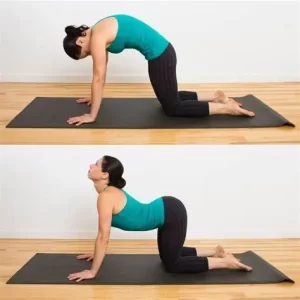
Cat-cow
- Start by placing your hands and knees on the floor in the tabletop position.
- Make sure that your back is straight.
- Maintain your feet and hands grounded.
- Take a breath, lift your head, and allow the air to fill your belly.
- For a short while, maintain this posture.
- Next, release the breath, tuck your chin into your chest, and tilt your back toward the ceiling.
- Your lower back is gently stretched.
- Take a few seconds to hold this position.
- Then return to your neutral position.
- Then relax.
- Repeat these exercises 5 to 10 times.
Lower back stretch
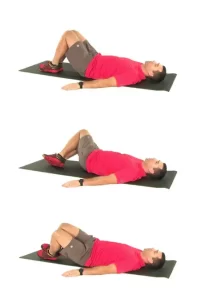
- It’s comfortable to start on your back.
- Bend both knees.
- Your feet should remain flat on the ground.
- Inhale deeply.
- Make sure your shoulders are firmly planted.
- Bend over on one knee.
- Observe the opposite side now.
- For a few seconds, maintain this posture.
- Then return to your neutral position.
- Then relax.
- Repeat these exercises 5 to 10 times.
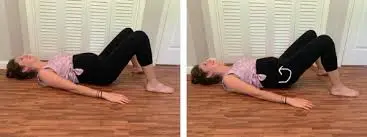
Pelvic tilt
- Bend your knees and place your feet flat on the ground while lying on your back.
- You should have your hands by your sides or on your hips.
- Keep your lower back slightly open and your posture neutral.
- Make sure your lower back is level with the floor and that your abdominal muscles are contracted.
- Imagine your pelvis tilting upward as you pull your belly button towards your spine.
- Hold the tilted position for a few seconds while you breathe normally.
- Then return to your neutral position.
- Then relax.
- Repeat these exercises 5 to 10 times.
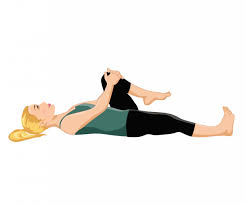
Knee to chest
- To start, lie on your back with your feet flat on the floor.
- Your hand should be positioned behind your knee or directly beneath your kneecap.
- Your knee should now be raised to your chest.
- Maintain this posture for a short while.
- Release your leg after that.
- Then return to your neutral position.
- Then relax.
- Repeat these exercises 5 to 10 times.
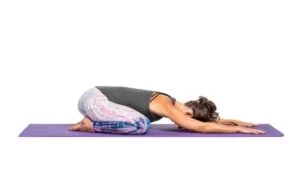
Child’s Pose
- With both knees directly beneath your hips and your feet plantar flexed so that your big toes touch, kneel.
- Start extending your knees in the direction of the mat’s edge.
- To stabilize your spine, tighten your abdominal muscles and retract and depress your scapulae without arching your lower back.
- With your fingers pointing forward, place your hands on the ground directly beneath your shoulders as you slowly lean forward.
- Take a breath.
- Breathe out and flex at the hips, bringing your glutes to your heels while keeping your hands planted.
- Stretch through your arms and back while you recline, keeping your glutes and heels connected.
- Keep your shoulders away from your ears as you pull them back and down.
- Place your forehead on the ground and your chest between your thighs.
- Breathe in as you extend your upper body and lengthen your spine, then release the breath as you fold deeper into the pose and widen your knees as needed.
- Hold this position for a few seconds.
- Then return to your neutral position.
- Then relax.
- Repeat these exercises 5 to 10 times.
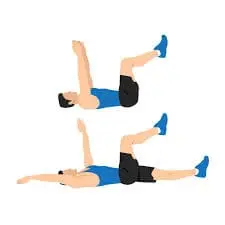
Dead Bug
- The right core engagement ought to come first.
- Bend your legs and raise your arms straight up over your body while lying on the ground.
- Breathe in, then force your back into the floor by contracting your abs, making sure there is no gap between breaths.
- Make sure your legs are parallel to the floor.
- Just extend as far as you can once your back is off the ground.
- Hold this position for a few seconds.
- Then return to your neutral position.
- Then relax.
- Repeat these exercises 5 to 10 times.
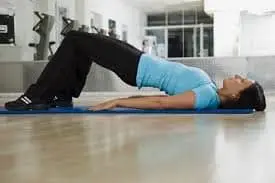
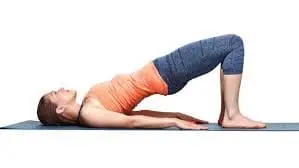
Bridging
- Start with the supine position on the floor.
- Next, bend both knees.
- You should be able to reach your heels with your fingers.
- Press your shoulders firmly into the floor.
- Lift your hips and apply pressure to your feet.
- Slowly raise your hips toward the ceiling by pressing them into your arms and feet while holding your hands beneath you.
- Hold this position for a few seconds.
- Then return to your neutral position.
- Then relax.
- Repeat these exercises 5 to 10 times.
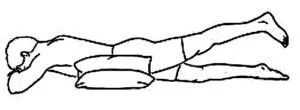
Prone hip extension
- On a cozy surface, like an exercise mat, begin by lying prone, or face down.
- With your head neutral or your forehead resting on the mat, extend your arms in front of you.
- Keep your legs straight and together with your toes pointing down toward the floor.
- Using your hamstrings and glutes, slowly lift one leg off the ground while keeping it straight.
- To raise your leg, focus on using your glutes rather than your lower back.
- Lift the leg as high as you can without arching your back or shifting your pelvis.
- Your entire body should remain still except for the raised leg.
- Use both your lower back and gluteal muscles to tighten your glutes for a few seconds while your leg is at the top.
- Maintain a strong core to support your spine.
- Slowly return your leg to the starting position while maintaining control.
- Keep the leg from falling too soon.
- Then return to your neutral position.
- Then relax.
- Repeat these exercises 5 to 10 times.
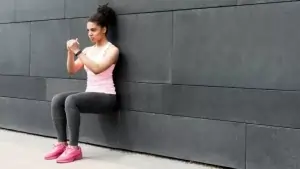
Wall sit
- Walk your feet forward while standing with your back to the wall.
- Once your thighs are parallel to the floor, slide down the wall.
- Make sure your feet are shoulder-width apart.
- Your knees should be bent at a 90-degree angle and over your ankles.
- To establish a stable position, evenly distribute your weight and use your feet to grasp the floor.
- Press your head and upper body up against the wall.
- Throughout the exercise, your chin should stay tucked.
- Engage your core and strengthen your hips and shoulders.
- Hold the squat position for a few seconds while keeping your posture and full-body relaxation.
- Then return to your neutral position.
- Then relax.
- Repeat these exercises 5 to 10 times.
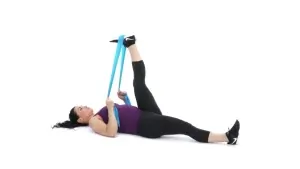
Lying hamstring stretch
- Lie flat on your back and find a comfortable position.
- For this exercise, you will require a strap or resistance band.
- Holding the ends of the strap in both hands, loop it beneath the arch of one foot.
- Using your arms as support, slowly and gently raise your straight leg toward the ceiling.
- Keeping your knee straight, raise your leg as high as you can.
- Keeping your hands close to your chest will make the exercise more comfortable.
- For a short while, maintain the static stretch.
- Then return to your neutral position.
- Then relax.
- Repeat these exercises 5 to 10 times.
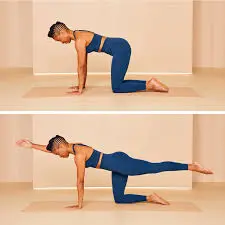
Bird dog
- Start by sitting on the surface of the table and relaxing on all fours.
- Put your hands under your shoulders and your knees under your hips.
- Maintain a neutral spinal posture.
- Squeeze your shoulders together.
- Next, raise your right arm and left leg to the highest point.
- You should keep your shoulders and hips parallel.
- Hold this position for a few seconds.
- Then return to your neutral position.
- Then relax.
- Repeat these exercises 5 to 10 times.
- Do the exercise again on the opposite side of your body.
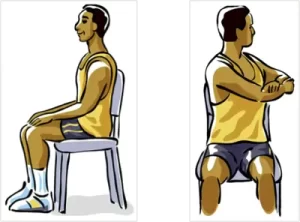
Seated trunk rotation
- With your feet flat on the ground, take an upright seat in a chair.
- Maintain a straight back and forward, stable hips.
- Put your hands on your thighs or fold your arms across your chest.
- Maintaining the proper position of your head and shoulders, slowly rotate your upper body to one side.
- Hold this position for a few seconds.
- After a few seconds of holding, go back to the center.
- Then return to your neutral position.
- Then relax.
- Repeat these exercises 5 to 10 times.
- On the opposite side, repeat the motion.
What safety measures should be taken when exercising?
Start by warming up.
- Always begin with gentle, active motions.
- This lessens the possibility of making the stress worse by warming the muscles, increasing blood flow, and reducing stiffness.
Utilize supportive surfaces.
- For your workouts, use a yoga mat or another firm, cushioned surface.
- Avoid extremely soft mattresses and hard flooring to avoid back pain.
Gradually and slowly stretch.
- Don’t jump or stretch too much.
- For a few seconds, hold each stretch without exerting any pressure.
Start slowly and work your way up.
- Start with simple, low-intensity exercises and only increase the difficulty under supervision.
- Avoid starting more difficult activities right away, even if the pain has gone away.
Keep an eye out for any swelling or pain.
- Exercises that cause severe or worsening pain should be discontinued.
- While slight pain is typical, an ache during or after an activity may be a sign that you’re overdoing it.
- Use ice to reduce inflammation following physical activity.
Make Use of the Correct Form and Method
- A poor form can worsen a pain or lead to other issues.
- Use mirrors or supervision if necessary to keep an eye on posture.
Breathe as usual
- Holding your breath increases spinal pressure, so avoid doing so while performing exercises.
After your exercise, relax.
- Stretching gently and breathing in a controlled manner can prevent muscle relaxation and stiffness.
- Avoid stopping suddenly without doing any recovery exercises.
Take a Rest When Needed
- If you feel worn out or have symptoms after a session, take a break.
- Excessive training can delay recovery or cause flare-ups.
When did you stop working out?
Severe or radiating pain
Severe or radiating pain. Stop right away if you come across:
- Quick, severe, or intense pain
- Burning, tingling, or numbness
Spasms or cramps in the muscles
- Stop exercising if your lower back starts to spasm or cramp unexpectedly.
- This could indicate that your muscles aren’t prepared for this degree of effort or are overworked.
When Pain Is Too Long After Exercise
- If pain doesn’t start right away and lasts longer than 24 to 48 hours after working out, it may indicate poor technique or overuse.
Whenever the symptoms worsen or return
- Resuming exercise too soon after feeling better can lead to re-injury.
- Instead of making the necessary adjustments, they might stop all activities if the pain returns.
Due to a lack of supervision or direction
- Patients may stop exercising if they are unsure, especially if they:
- Don’t know which movements are safe
- Fear has more negative effects than positive ones.
- When you don’t see improvement, give up.
If you have a lumbar strain, what kinds of exercises should you avoid?
The goal is to allow the injured muscles to heal while avoiding activities that worsen your lower back if you have a lumbar strain.
The following movements and exercises should be avoided until the pain goes away:
Strong-Impact Activities
- Exercises for jumping (box jumps, jump squats)
- Running on uneven surfaces
- High-level aerobic exercises
Activities for Forward Flexion
Bending forward puts more strain on the lumbar spine and tense muscles.
- Toe touches
- Sit-ups/crunches
- Leg raises with a straight back
Heavy Lifting and Bending with Weights
These put the damaged lumbar muscles under a lot of strain.
- Deadlifts
- Squats with heavy weights
- Kettlebell swings
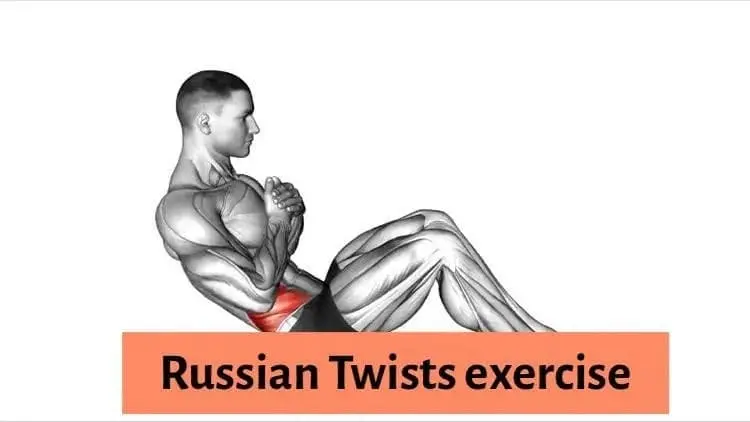
Rotating Motions
Healing muscle tissue can be pulled by twisting.
- Core exercises with rotation
- Russian twists
Deep Back Extension Exercise
In the early stages of healing, the lower spine is compressed by excessive extension.
- Back hyperextensions
- The deep cobra pose
What lifestyle changes can be made to avoid lumbar strain?
Simple, regular lifestyle adjustments can greatly protect your lower back and maintain the health of your spine by preventing lumbar strain.
The most effective ones are as follows:
Avoid high-impact activities
- Sudden twisting, jerky motions, and severe strain.
- Before doing any activity, properly warm up.
Proper Lifting
- Bend at the knees rather than the waist.
- Hold the item close to your body.
- When lifting, do not twist.
- When transporting heavy objects, ask for assistance.
Keep Moving (Avoid Extended Standing/Sitting)
- Every 30 to 40 minutes, take breaks.
- Stretch frequently, especially your glutes, hamstrings, and hip flexors.
- If at all possible, use a standing desk or switch positions frequently.
Keep Your Body Weight in Monitor
- Lumbar spine strain is increased by excess body weight.
- Frequent exercise and a well-balanced diet help lessen stress.
Enhance Your Posture
- Place your feet flat on the floor and support your back as you sit.
- Don’t lean forward or slouch for extended periods of time.
- Screen height should be maintained.
- When standing, equally distribute your weight across both feet.
Sleep in the Correct Positions
- Either sleep on your back with a pillow under your knees or on your side with a pillow between your knees.
- Choose a mattress that is supportive but not overly soft or firm.
Ergonomic Changes for Work and Home
- Make use of lumbar support chairs.
- Keep your keyboard near you.
- To prevent bending forward, adjust the height of your desk.
Summary:
An injury to the lower back is called a lumbar strain. This results in sore, rigid muscles and tendons. Your lower back’s portion of the spine is made up of the lumbar vertebrae. The muscles and tendons in the lower back can be harmed by an injury.
Lumbar strains can result from pushing and pulling in sports like football or weightlifting. Sports that require abrupt twisting of the lower back can also do this. Tennis, basketball, baseball, and golf are a few of these.
A common part of the healing process for those with lower back strains is physical therapy. To meet each patient’s unique needs, it incorporates a range of methods and choices.
The best way to relieve your symptoms is to incorporate low-impact exercise into your daily routine. For those with lower back pain, the combination of slow, controlled motions with a focus on flexibility and strength training can improve posture, reduce stress, increase core stability, and strengthen muscles throughout the body.
FAQ:
A lumbar strain: what is it?
An injury to the back’s muscles or tendons caused by overstretching, sudden movements, poor lifting technique, or repeated stress is commonly referred to as a lumbar strain.
Can someone with a lumbar strain exercise?
Indeed, mild exercise can enhance mobility, lessen pain, and speed up healing. Stay away from painful movements and begin slowly.
Can you avoid lumbar strains in the future with exercise?
Definitely. Reinjury risk can be greatly decreased by strengthening your core and maintaining proper posture.
Does walking alleviate lumbar strain?
Indeed, walking promotes healing, lowers stiffness, and increases blood flow. Take short, relaxing walks at first, then progressively extend them.
How long does exercise take for recovery?
With regular stretching, strengthening, and good posture, the majority of mild-to-moderate lumbar strains heal in two to six months.
How frequently should I perform these exercises?
Depending on your level of pain and tolerance, stretch 1-2 times a day and 3-4 times a week.
Which workouts are safe for people with lumbar strains?
Pelvic tilts
Cat-cow stretch
Knee-to-chest stretch
Child’s pose
Bridge exercise
Lower back rotational
Which exercises should I stay away from if I have a lumbar strain?
Heavy lifting, Bending deeply forward under load, High-impact exercises (running, jumping), Quick twisting motions
What long-term impact can a lumbar strain cause?
If left untreated, lumbar strains can result in chronic inflammation, muscle weakness, and long-term lower back instability. Over time, this could result in chronic pain, nerve irritation, and decreased mobility, potentially leading to irreversible spinal damage.
A lumbar strain: can you massage it?
Back pain may be short-term, if at all, relieved by passive therapies like massages or heat therapy. A few of these therapies can help you feel better. The most effective way to relieve non-specific low back pain is through active treatment.
Which factors increase the risk of lumbar strain?
Lumbar strain can result from sports injuries, overuse, or unexpected injuries. Obesity, weak abdominal or back muscles, tight hamstrings, and lower back curvature are risk factors for lumbar strains.
How should a lumbar strain be treated?
One possible course of treatment is rest. Heat and compression are applied to the back, or ice packs. Strengthening exercises for the abdominal muscles.
Is it possible to massage a lumbar strain?
Many lower back issues can significantly improve with massage therapy. In particular, when the right muscle is targeted, back strain pain can be managed at its origin for more rapid and long-lasting relief.
What effects does a lumbar strain have over time?
Insufficient care for a lumbar strain can result in persistent lower back instability, muscle weakness, and chronic inflammation. This could eventually lead to persistent pain, nerve irritation, and decreased mobility, which could cause long-lasting damage to your spine.
Does poor posture impact lower back pain?
Long-term bad posture is a possible risk factor for lumbar spine injuries, and some common postural issues can cause lumbar pain.
References:
- Hamilton, K., MD (September 8, 2017). exercises for strained lower back muscles. Health of the spine. https://www.spine-health.com/conditions/lower-back-pain/exercises-lower-back-muscle-strain
- Cadman, B. (14 April 2025). How to make the lower back stronger. https://www.articles/323204/medicalnewstoday.com
- https://www.hopkinsmedicine.org/health/conditions-and-diseases/weight-lifters-back/lumbar-strain
- B. Physio and B. Physio (2025, June 30). Benchmark Physio offers 13 of the best exercises for lower back pain. Physio Benchmark. Physiotherapy exercises for lower back pain can be found at https://benchmarkphysio.com.au/
- The top ten exercises for lower back pain relief in physical therapy. (n.d.). https://www.movementforlife.com/articles/physical-therapy-lower-back-pain-10-best-exercises-relief
- April 8, 2024, American Association of Neurological Surgeons. AANS: https://www.aans.org/patients/conditions-treatments/low-back-strain-and-sprain/ Low back strain and sprain
- MoreGoodDays, July 26, 2024. Tips & Strategies for Treating Lower Back Strain. Treatment for lower back strain: https://www.moregooddays.com/post/
- Sorosky, S., MD. August 29, 2025. Clinic: https://www.desertspineandsports.com/blog/lower-back-exercises-to-prevent-spinal-injuries Five Lower Back Exercises to Prevent Back and Spinal Injuries