Cervical Spine Stabilization Exercises: A Complete Guide to Neck Strength, Posture, and Pain Relief
Neck Stabilisation Exercises
Neck stabilisation exercises aim to strengthen the neck, promote good posture and control, and decrease strain on the neck. There are 7 vertebrae in the cervical spine – these form the neck and allow the head to bend, rotate and tilt.
Poor Neck Strength and/or posture, long periods of sitting, and high screen and phone usage can all contribute to neck pain. Neck stabilisation exercises can therefore assist in improving deep neck muscle control and endurance, which is important for good head and neck posture.
Neck stabilisation exercises can be beneficial to those suffering from slight neck pain, poor posture and/or Neck Strength, and/or those having difficulty in keeping their neck in a good position. Carried out correctly and regularly, this type of exercise may aid neck function, decrease muscular tension, and improve control.
What are Cervical Stabilisation Exercises?
Neck stabilisation comprises controlled exercises and stimulation which in turn help to strengthen neck muscles. Unlike other types of exercise, which tend to emphasise greater movement, neck stabilisation is concerned with maintaining good posture and stimulating deep neck muscles.
There are a number of muscles in the neck which are involved in head support, control and stabilisation. These include the deep cervical flexor and extensor muscles, as well as the upper trapezius and levator scapulae muscles, alongside other muscles involved in head control and posture.
Typically, neck stabilisation aims to:
- Improve deep neck muscle control and endurance.
- Promote and maintain correct neck posture.
- Increase co-ordination between neck and shoulder muscles.
- Decrease overactivity and strain.
- Develop postural awareness.
- Enable good head and neck control.
Generally, neck stabilisation is carried out at a slow pace.
Benefits of Neck Stabilisation Exercises
Depending on an individual’s condition, neck stabilisation can offer a number of benefits if the exercises are carried out in the correct manner.
- Promotes deep neck muscle strengthening
Deep neck muscles are involved in head support and posture. Stimulation of these muscles can therefore enhance their control and endurance and, in turn, help to maintain good neck stability.
- Encourages good neck posture
Poor posture, and in particular, forward head posture, can place additional strain upon the neck. Neck stabilisation can therefore promote good head posture and also increase postural awareness.
- Decreases neck muscle over-activity
Individuals with inadequate or poor co-ordination of neck muscles can sometimes suffer from over-activity of these muscles, for example when working on a computer, reading, driving and/or using a phone. Neck stabilisation may thus assist in enhancing neck muscle endurance and in turn promote greater ease in these tasks.
- Promotes head and neck control
Good head and neck control is essential to enable good movement. Neck stabilisation can therefore assist in achieving better control of the head and neck when moving the arms, changing posture and/or balancing.
- May alleviate mechanical neck pain
For some individuals, mechanical neck pain is related to poor neck control, strength and/or postural strain. An appropriately chosen programme of neck stabilisation may aid in easing such mechanical neck pain and enhance physical function.
- Promotes neck and shoulder co-ordination
Neck and shoulder muscles are involved in upper body support. Together with shoulder blade control exercises, neck stabilisation can assist in improving co-ordination and also in limiting over-activity of neck and upper shoulder muscles.
Muscles Involved in Neck Stabilisation
Understanding which muscles are involved in neck stabilisation is useful.
- Deep cervical flexor muscles – The longus colli and longus capitis muscles are involved in head flexion. They also help to control and maintain neck posture.
- Cervical extensor muscles – These muscles help to keep the head upright and provide control of neck extension.
- Upper trapezius – This muscle provides support for the shoulder girdle and is involved in head and shoulder function.
- Levator scapulae – This muscle links the cervical spine to the scapula. It is also involved in scapula elevation and head and neck function.
- Scapular stabiliser muscles – For example, the middle and lower trapezius and serratus anterior muscles are involved in providing scapula control. They in turn can therefore indirectly aid in promoting good neck posture.
Therefore, a good neck stabilisation programme will incorporate both neck and upper back, together with scapular stabilising muscles.
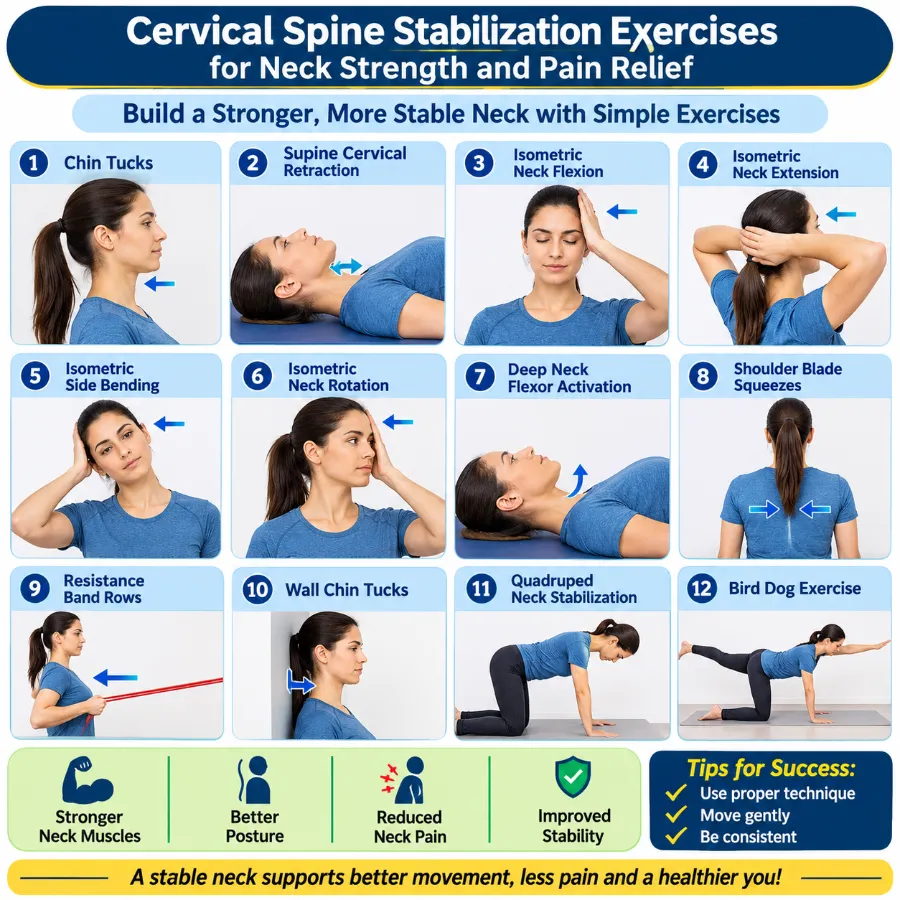
Top Cervical Stabilisation Exercises
A number of the exercises detailed below can be carried out at home. Initially, carry out movements in a smooth and easy manner and ensure that your neck remains in a comfortable position.
- Chin Tuck
Chin tucks are frequently used to stimulate the deep cervical flexor muscles and to encourage good head posture.
To carry out this exercise:
- Sit or lie down with your head comfortably supported.
- Ensure your vision is straight ahead.
- Gently pull your chin backwards, so as to form a slight double chin.
- Ensure that your head remains level – do not lift or lower it.
- Hold in this position for 3-5 seconds.
- Then, ease yourself back into the initial position.
- Number of repetitions: 10-12
Benefits: Stimulates deep neck muscles. Encourages correct head posture. Helps to limit forward head posture.
- Supine Cervical Retraction
This exercise is used to strengthen head control muscles and can be performed whilst lying down.
To carry out this exercise:
- Lie on your back.
- Keep your knees bent and feet on the floor.
- Allow your head to rest comfortably.
- Gently bring your chin towards your chest, ensuring that you do not lift your head.
- Hold this position for 5 seconds.
- Ease yourself back into the original position. Repeat.
- Number of repetitions: 10
Benefits: Assists in promoting good neck posture. Encourages neck muscle control. This exercise is also low impact as it is performed in a supine position.
- Isometric Neck Flexion
This is another exercise used to strengthen front neck muscles. Unlike some neck exercises, there is little visible movement of the neck.
To carry out this exercise:
- Sit up and relax your shoulders.
- Rest your palm on your forehead.
- Gently press your forehead against your palm.
- Use your palm to resist this pressure so that your head does not move.
- Hold in this position for 5 seconds.
- Ease yourself back into the original position. Repeat.
- Number of repetitions: 8-10
Benefits: Strengthens the neck flexor muscles. Assists in maintaining head control.
- Isometric Neck Extension
This exercise stimulates the neck muscles which are involved in head support.
To carry out this exercise:
- Sit or stand and ensure that your back is in a relaxed upright position.
- Place both hands behind your head.
- Gently press your head backwards against your hands.
- Use your hands to resist this so that your head does not move.
- Hold in this position for 5 seconds.
- Fully relax and then repeat.
- Number of repetitions: 8-10
Benefits: Strengthens cervical extensor muscles. Assists in maintaining upright head posture.
- Isometric Lateral Neck Flexion
This type of exercise stimulates neck muscles that control lateral neck function.
To carry out this exercise:
- Sit and ensure that your head is in a neutral position.
- Place your right hand on the right-hand side of your head.
- Gently move your head towards your hand. Ensure that your head does not move.
- Hold in this position for 5 seconds.
- Relax and then repeat on the other side.
- Number of repetitions: 8 (on each side)
Benefits: Strengthens muscles which control lateral neck function. Assists in promoting good lateral neck control.
- Isometric Neck Rotation
This exercise is used to strengthen the neck muscles that control neck rotation.
To carry out this exercise:
- Sit and relax your shoulders.
- Place your right hand on the right-hand side of your forehead or temple.
- Attempt to turn your head to the right. Use your hand to resist this movement.
- Ensure that your head remains still.
- Hold in this position for 5 seconds.
- Repeat on the left-hand side.
- Number of repetitions: 8 (on each side)
Benefits: Assists in strengthening neck rotator muscles. Promotes good neck rotational control.
- Deep Neck Flexor Stimulation
This exercise is used to stimulate the deep front cervical muscles.
To carry out this exercise:
- Lie on your back with your knees bent.
- Allow your head to rest comfortably.
- Gently move your head in a ‘yes.’ motion.
- Ensure that you do not lift your head off the floor.
- Whilst continuing to breathe normally, hold this slight head movement for 5 seconds.
- Ease yourself back into your initial position.
- Number of repetitions: 10
Benefits: Assists in stimulating deep neck muscles. Can also help to reduce over-activity of superficial neck muscles.
- Scapular Squeeze
By strengthening upper back muscles, this exercise can also enhance scapula control. Good scapula control can in turn contribute to improved neck posture.
To carry out this exercise:
- Sit or stand and allow your arms to hang naturally at your sides.
- Ensure that your shoulders are not close to your ears.
- Gently squeeze your scapulae together.
- Avoid rounding of your lower back and/or shrugging of your shoulders.
- Hold in this position for 5 seconds.
- Ease yourself back into your initial position.
- Number of repetitions: 12-15
Benefits: Strengthens upper back muscles. Encourages good scapula and neck control.
- Resistance Band Rows
Resistance band rows can be used to strengthen upper back muscles together with scapula muscles, which in turn can provide head and shoulder support.
To carry out this exercise:
- Attach a resistance band to a secure point at approximately chest height.
- Sit or stand and hold the band in front of you with your arms outstretched.
- Keep your back upright and your neck in a neutral position.
- Pull the band towards you, bending your elbows as you do so.
- Gently squeeze your scapulae together.
- Slowly return your arms to their initial position.
- Number of repetitions: 10-15
Benefits: Strengthens upper back muscles. Encourages good scapula control. Enhances postural endurance.
- Wall Chin Tuck
Like the supine cervical retraction exercise, the wall chin tuck promotes good head control and also postural awareness. It is performed in a standing position.
To carry out this exercise:
- Stand with your back against a wall.
- If possible, allow your head to also rest comfortably against the wall.
- Relax your shoulders and ensure that your vision is level.
- Gently pull your chin back. Again, do not tilt your head.
- Hold in this position for 5 seconds.
- Relax and then repeat.
- Number of repetitions: 10
Benefits: Encourages good posture. Assists in developing awareness of head position when standing.
- Quadruped Neck Control
This exercise requires the neck muscles to demonstrate good control when an individual is in a hands and knees position.
To carry out this exercise:
- Get into a hands and knees position. Ensure that your hands are beneath your shoulders and your knees are underneath your hips.
- Keep your spine neutral and ensure that your head is in line with your upper back.
- Gently pull your chin back.
- Control your neck and continue to breathe normally.
- Hold in this position for 10 seconds.
- Relax and then repeat.
- Number of repetitions: 8-10
Benefits: Enhances neck control. Encourages good postural control. Promotes good co-ordination. This is also a weight-bearing exercise.
- Bird Dog Exercise
In addition to strengthening the core, the Bird Dog exercise also promotes good spinal control. It can further enhance upper and lower body co-ordination and encourages good neck control to be maintained.
To carry out this exercise:
- Get into a hands-and-knees position.
- Ensure that your neck is in line with your spine. Also, ensure that your vision is directed to the floor.
- Slowly extend your right arm forwards and your left leg backwards.
- Ensure that you do not twist your torso and avoid lifting your head.
- Hold in this position for 3-5 seconds.
- Return to your initial position and then repeat on the other side.
- Number of repetitions: 8-10 (on each side)
Benefits: Promotes good core and postural control. Encourages good upper/lower body co-ordination. Also assists in maintaining good neck control.
Cervical Spine Stabilization Exercise Routine
Beginners can combine several of the above exercises into a simple routine. Perform the exercises slowly and avoid excessive resistance or movements that increase discomfort.
| Exercise | Repetitions | Hold |
|---|---|---|
| Chin Tucks | 10 | 5 seconds |
| Deep Neck Flexor Activation | 10 | 5 seconds |
| Isometric Neck Flexion | 8 | 5 seconds |
| Isometric Neck Extension | 8 | 5 seconds |
| Isometric Side Bending | 8 each side | 5 seconds |
| Isometric Neck Rotation | 8 each side | 5 seconds |
| Shoulder Blade Squeezes | 12 | 5 seconds |
| Resistance Band Rows | 12 | Controlled movement |
| Bird Dog | 8 each side | 3–5 seconds |
Suggested frequency: 3–5 days per week, depending on comfort, tolerance, and individual needs.
Whilst beginning an exercise programme, it is not essential to complete all of the above exercises in one session. Gradually add extra exercises and/or increase the number of times that each exercise is carried out as your neck becomes more comfortable and strengthened.
How to Safely Undertake Neck Stabilisation Exercises
As the neck supports the head and contains delicate structures, correct execution of neck stabilisation exercises is important.
- Ensure that your head is in line with your spine where possible.
- Avoid making fast, forceful and/or jerky neck movements.
- Apply light resistance when carrying out isometric exercises.
- Do not hold your breath when stimulating your neck muscles.
- Relax your shoulders, rather than shrugging them towards your ears.
- Avoid forcing your neck into painful and/or restricted movements.
- Commence with brief holds and a limited number of repetitions if your neck muscles are currently weak.
- Gradually intensify your exercises. Avoid attempting to rapidly strengthen your neck muscles.
- Undertake exercises in a comfortable manner and take rest periods as required.
If undertaking neck stabilisation exercises results in increasing neck pain, together with/ or dizziness, headaches, nausea and/or numbness and/or tingling and/or pain travelling down your arm, then cease and obtain useful professional advice.
Common Errors to Avoid Whilst Carrying Out Cervical Stabilisation Exercises
Incorrect execution of stabilisation exercises can limit their effectiveness and also increase muscular strain.
Over-arching your chin
Undue retraction of the chin can cause unnecessary strain. Chin tucks should therefore be lightly executed.
Elevating the Head During Deep Neck flexor stimulation, excessive head elevation can result in superficial neck muscles becoming dominant. Try to simply lightly nod your head rather than elevate it excessively.
Applying excessive resistance
During isometric exercises, high resistance can lead to increased neck strain. Commence with light resistance and gradually increase this only if and when you are able to comfortably undertake the exercise.
Shrugging the shoulders
Shoulder shrugging can cause increased strain on the upper trapezius muscle. Therefore, ensure that your shoulders are relaxed and not drawn towards your ears.
Holding the breath in
Breathing can become restricted during neck exercises. Throughout stabilisation exercises, continue to breathe in a normal manner.
Exercising in pain
Whilst neck stabilisation exercises should not cause acute pain, if undertaking them leads to increasing levels of pain or other symptoms, then either lessen the intensity of your exercises or cease them.
Who Can Benefit from Neck Stabilisation Exercises?
Neck stabilisation may be suitable for:
- Individuals with slight mechanical neck pain.
- Those with poor neck muscle strength and/or endurance.
- Those who spend a great deal of time working at a computer.
- Those who frequently use phones and do so in poor postural positions.
- Those who suffer from forward head posture.
- Those whose neck muscles become over-active through long periods of sitting.
- Individuals who wish to improve their neck and upper back postural control.
- People recovering from specific neck conditions, as advised by a physiotherapist.
However, people with cervical disc issues and/or cervical spondylosis and/or nerve compression, together with those who have recently suffered neck trauma and/or are experiencing chronic neck pain, should first obtain professional advice before commencing a neck strengthening programme.
When Should You Not Undertake Neck Stabilisation Exercises?
Although light neck stabilisation exercises are frequently utilised by physiotherapists, not everyone and not all stages of recovery will be suitable for this type of exercise.
You should not commence self-directed neck strengthening exercises if you:
- Have recently experienced neck trauma.
- Are suffering from severe and/or worsening neck pain.
- Have recently developed arm and/or hand weakness.
- Are experiencing, and/or are seeing an increase in, numbness and/or tingling.
- Are having considerable dizziness and/or suffering from poor balance in relation to neck movements.
- Are suddenly experiencing severe headaches and/or are displaying atypical neurological symptoms.
- Have recently undergone cervical spine surgery and have not received permission to do so from your treating professional.
Seek urgent professional advice if you develop new neurological symptoms, experience severe neck pain after neck trauma and/or suddenly experience severe headaches in conjunction with neck pain.
How to Further Improve Neck Stability
Alongside exercise, an individual’s lifestyle can also affect their neck muscle endurance and postural control, and comfort.
Ensure that screens are at a comfortable viewing height
To prevent frequent forward neck bending, view computer screens from approximately eye level. Furthermore, adjust both your chair and desk so that your shoulders are in a relaxed position.
Avoid prolonged forward head posture
To minimise the need to gaze downwards at a mobile phone, hold it at a similar height to your eye level. Also, frequently alter your position. Avoid remaining in one position for extended periods of time.
Take regular breaks to move around
Those working at a desk should take brief periods of time to walk and move their shoulders. In addition, they should also occasionally alter their neck position. This should be done every 30-60 minutes.
Strengthen upper back muscles
Exercises to stimulate scapula and upper back muscles can aid in improving posture and limiting over-activity of neck muscles.
Sleep in a comfortable position
Choose a pillow which allows for good neck support. However, ensure that it does not encourage excessive neck flexion and/or extension. Ideally, you should therefore sleep in a comfortable and neutral neck position.
Continue to be physically active
Regular physical activity including walking, strength training and suitable mobility exercises is beneficial for general health. It can also help to counteract the impact of a sedentary lifestyle.
FAQ’s
How frequently should I undertake neck stabilisation exercises?
Most novices can initially perform these exercises 3-5 times per week. Furthermore, individuals may also be advised by a physiotherapist to undertake mild stimulation exercises on a daily basis. However, the exercise frequency should be tailored to an individual’s condition and recovery.
How Much Time Is Needed to Build Strength in the Neck Muscles?
Initial improvements in neck muscle control can often be seen after a few weeks of exercising. More marked improvements in muscle endurance and strength may, however, take 4-8 weeks or even longer to occur. This will depend on an individual’s initial muscle strength, together with their level of exercise adherence, symptoms and the intensity of the exercises that they are carrying out.
Are chin tucks good neck stabilisation exercises?
Yes. Chin tucks are commonly used to stimulate deep cervical flexor muscles and also to improve head and neck control. However, they should be undertaken in a light manner and without excessive force or head elevation.
Can neck stabilisation exercises help with forward head posture?
Neck stabilisation can potentially assist in raising postural awareness and in stimulating and enhancing deep neck muscle control and endurance. Nonetheless, forward head posture is affected by many variables including, for example, behaviour, upper back mobility, muscle endurance and individual anatomical structure. In some cases, a combination of neck, upper back and postural exercises may be more effective than chin tucks alone.
Can I undertake neck stabilisation exercises if I have cervical spondylosis?
Some people with cervical spondylosis can benefit from light neck strengthening and stabilisation exercises. Again, however, the most suitable exercises will depend on the severity of an individual’s pain, mobility and nerve involvement and other symptoms. Thus, it is advisable to first seek professional advice from a physiotherapist prior to beginning a neck exercise programme.
Do I need specialist equipment to undertake neck stabilisation exercises?
Generally, no specialist items are required to carry out neck stabilisation exercises. However, chairs, walls and/or yoga mats can be of assistance. Resistance bands can also be used to further strengthen upper back muscles.
Should I feel pain when undertaking neck stabilisation exercises?
Whilst generally these exercises should not be painful, a degree of muscle exertion and/or tiredness may be felt. Nevertheless, any sharp pain, increasing symptoms, dizziness or pain radiating down the arm should not be ignored.
Conclusion
Neck stabilisation programmes can aid one’s neck muscles, increasing their strength, stamina and control and also helping to sustain a good head and neck posture. A range of exercises which may be suitable to form part of a neck stabilisation programme include chin retraction, deep neck flexor exercise, isometric neck exercise, scapulae squeeze, elastic band rowing and Bird Dog.
It is important that exercises are carried out correctly. Light resistance should be used, and progression should occur. In addition, alongside neck exercise, good ergonomics, avoidance of sustained positions and routine activity changes can contribute to good neck health.
Should you suffer from ongoing neck pain, arm-related symptoms, much stiffness or have been diagnosed with a cervical condition, then it would be advisable to visit a physiotherapist who can provide a tailored exercise programme. This can assist in determining the most suitable exercises and enhance control. It can also aid continued rehabilitation.
References
1. Journal of Orthopaedic & Sports Physical Therapy (JOSPT) – Neck Pain: Clinical Practice Guidelines (2017).
https://www.orthopt.org/uploads/content_files/files/Neck%20Pain%20CPG%20-%20Revision%202017.pdf
2. PubMed – Evaluating the Impact of Cervical Stabilisation Exercises on Chronic Neck Pain: A Systematic Review (2025).
https://pubmed.ncbi.nlm.nih.gov/40286070/
3. Oxford Academic – Physical Therapy Journal – Clinical Practice Guideline for Physical Therapy Assessment and Treatment in Patients With Nonspecific Neck Pain.
https://academic.oup.com/ptj/article/98/3/162/4689128
4. British Journal of Sports Medicine (BJSM) – Comparative Effectiveness of Physical Exercise Interventions for Chronic Non-Specific Neck Pain: A Systematic Review and Network Meta-Analysis.
https://bjsm.bmj.com/content/early/2020/11/02/bjsports-2020-102664
5. NHS Inform – Exercises for Neck Muscle and Joint Problems.
https://www.nhsinform.scot/illnesses-and-conditions/muscle-bone-and-joints/neck-and-back-problems-and-conditions/exercises-for-neck-problems
6. NHS – Neck Pain: Causes, Treatment, and Prevention.
https://www.nhs.uk/symptoms/neck-pain-and-stiff-neck/
7. Chartered Society of Physiotherapy (CSP) – Managing Your Neck Pain.
https://www.csp.org.uk/conditions/managing-pain-home/managing-your-neck-pain
8. NHS Greater Glasgow and Clyde – Neck Physiotherapy Exercises and Self-Help Resources.
https://www.nhsggc.scot/hospitals-services/services-a-to-z/musculoskeletal-msk-physiotherapy/self-help-and-information-neck/