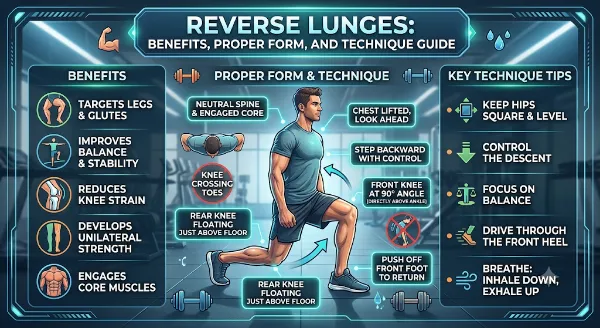
Reverse Lunge: Benefits, Proper Form, and Technique Guide
Introduction:
The Reverse Lunge is an effective lower-body exercise that involves stepping one foot backward while bending both knees to lower your body.
Stepping backward increases the load distribution toward the hip extensors- your glutes and hamstrings– while still striking the quadriceps hard, in contrast to forward lunges, where the deceleration forces on the front knee can be significant.
Reverse lunges are a wise option for lifters controlling knee sensitivity since they generate less anterior shear pressure at the knee than forward walking lunges, according to research published in the Journal of Strength and Conditioning Research.
However, the movement only offers those advantages provided your technique is correct. This is a comprehensive explanation of reverse lunge form, including everything from the anatomy and methodical execution to the programming numbers required to truly produce results and the faults that subtly undermine your progress.
What is a Reverse Lunge?
A lower-body exercise that mainly works the quads and glutes is the reverse lunge.
The reverse lunge entails moving backward, as opposed to the conventional forward lunge, which includes stepping forward.
It’s a more joint-friendly choice that still offers a difficult exercise because of the slight change in movement direction that can lessen the strain on your knees.
Because they imitate everyday motions like stepping back to avoid obstacles or descending stairs, reverse lunges are preferred in functional training.
Reverse lunges are a great addition to any exercise regimen since they enhance balance, coordination, and general lower body strength in addition to many other advantages.
Reverse Lunge Muscles Worked:
The glutes, hamstrings, and quadriceps are the main muscles used in the reverse lunge; the core is also used for stabilization.
The muscles used during reverse lunges are examined in further detail below:
- Gluteal Muscles: The reverse lunge strengthens and expands the buttocks by putting a lot of stress on the gluteus maximus.
- Hamstrings: Found at the back of your thighs, the hamstrings play a major role in the reverse lunge’s essential knee-bending and hip extension movements.
- Quadriceps: When you lunge back, the quads, which are found at the front of your thighs, help to extend the knee and support your leg.
- Core Muscles: Keeping your spine neutral during the exercise requires using your core to maintain balance and good posture.
As you lower your body and push back to the starting position, secondary muscles like the adductors and calves also help with balance and coordination.
Benefits of the Reverse Lunge Exercise: Why are Reverse Lunges Good for You?
Reverse lunges are beneficial for both daily movers and athletes since they combine strength, stability, and joint-friendly mechanics.
Their backward-stepping technique engages the main lower body muscles while spreading force to safeguard delicate joints.
Reverse lunges are still among the best single-leg exercises for developing functional strength and long-term durability because of these benefits.
Joint-Friendly Mechanics:
Compared to forward lunges, reverse lunges reduce knee forward shear, which can reduce joint stress.
Because of this, they are a sensible choice for those who have knee pain or for athletes recovering from lower-body injuries.
Backward-stepping variants are supported by clinical studies as a way to lessen patellofemoral loading, which may enhance tolerance during high-volume training sessions or recovery.
Improved Balance and Stability:
Your center of mass is shifted when you step backward, forcing your body to stabilize more dynamically.
The deep stabilizers of the hips and core, which are crucial for both injury prevention and athletic movement, are strengthened by this increased stress.
Reverse lunges can help with everyday chores, change-of-direction workouts, and sport-specific agility by improving balance.
Better Muscle Symmetry:
By isolating each leg, reverse lunges facilitate the identification and correction of left-to-right strength disparities.
Because it reduces compensatory movements and improves biomechanics while sprinting, jumping, and decelerating, single-leg strength training is commonly advised for athletes.
Performance is enhanced, and the risk of overuse injuries is reduced when both sides are balanced.
Increased Glute Activation:
Because of the backward stride and hip-dominant movement pattern, reverse lunges put additional strain on the glutes and hamstrings.
Because of this, they are a useful tool for strengthening the posterior chain without placing undue strain on the spine.
Increased glute activation also promotes hip stability, which is necessary for long-term lower-body joint health and knee stability.
Functional Strength for Real-Life Movement:
The reverse lunge’s movement pattern mimics real-world exercises, including bracing during sudden direction changes, stepping backward, and dropping into a half-kneeling stance.
Developing these patterns improves your capacity to move with assurance both in everyday situations and when participating in sports.
Reverse lunges help the body get ready for more difficult unilateral exercises by strengthening coordination and improving motor control.
Who Should Try Lunges?
- Lunges for beginners scale exquisitely. As you gain strength, start with bodyweight reverse lunges while balancing against a wall. No prior experience with exercise is required.
- Women: The idea that strength training increases muscle mass is a common error. Lunges promote bone health while exercising and shaping the glutes and legs. They’re a good choice for female strength training objectives.
- Lunges for Older Adults: As people age, balance, leg strength, and bone density become more and more essential. If you already have knee or hip issues, see your doctor. Start with supported reverse lunges while gripping a chair.
- Working Professionals: A 10- to 15-minute lunge circuit reduces the stiffness caused by prolonged sitting and requires no special equipment. A convenient option for a short exercise session before starting your day or during your lunch break.
Reverse Lunge Video
Reverse Lunge Form: How to Do a Reverse Lunge Correctly
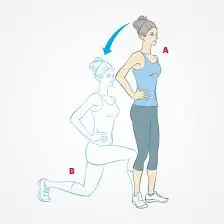
Using correct form when performing reverse lunges helps you get the most out of the exercise while minimizing the chance of injury.
To perform a reverse lunge correctly, follow these steps:
- Repeat: Before moving on to the second leg, finish the required number of repetitions on one side.
- Start Position: Take a tall stance with your feet hip-width apart and your hands on your hips for balance or your arms at your sides.
- Step Back: Using your right foot, take a careful step back while maintaining your heel off the ground and landing on the ball of your foot.
- Reduce Your Body: Lower your hips as you take a step back until your right knee is slightly above the floor and your left thigh is parallel to the floor. 90-degree angles should be formed by both knees.
- Engage Your Core: Throughout the exercise, maintain a straight back and an active core. Refrain from arching your back or bending forward.
- Return to Start: Bring your right foot forward to meet your left, then push through your left heel to return to the starting position.
Here’s a simple guide to help you use the exercise and get the best results:
- Start with Bodyweight: Before adding resistance, start with bodyweight reverse lunges to make sure your form is perfect.
- Include in Warm-Ups: To stimulate your lower body and get ready for more difficult activities, include reverse lunges in your dynamic warm-up.
- Gradually Increase Reps: As your strength and endurance build, start with fewer repetitions and progressively increase.
- Add Variations: To make your exercises more difficult, try adding variations like the landmine exercise or elevated reverse lunge once you’re comfortable with the basic reverse lunge.
Reverse Lunge Alternatives:
Consider these options if you want to change up your routine or find workouts that go well with the reverse lunge:
- Forward Lunges: A classic lunge that offers a slightly different pattern of muscle activation by having you stride forward rather than back.
- Split Squat: A more concentrated exercise for the quadriceps and glutes, this static variation of the lunge involves lowering and raising your body while keeping your feet in a split stance.
- Step-Up: A functional exercise that targets similar muscles by simulating the motion of climbing stairs by stepping onto an elevated platform.
- Reverse Lunge with Knee Drive: To strengthen the core and enhance balance, drive the back knee up toward your chest after finishing the lunge.
- Reverse Slide Lunge: Rather than stepping backward, slide your foot backward using a pair of glide discs.
- Elevated Reverse Lunge: This exercise requires you to walk back onto an elevated surface, such as a step or platform, adding a level of difficulty. This version strengthens the glutes and hamstrings and expands the range of motion. Select a platform height for the elevated reverse lunge that will enable you to execute the exercise with correct form.
- Increased Difficulty: The workout is more intense since you have to work over a wider range of motion due to the elevation.
- Increased Glute Activation: This variation is great for working the posterior chain because the deeper lunge position increases glute engagement.
- Bulgarian Split Squats: This sophisticated single-leg exercise raises the rear foot to improve lower-body strength, glute activation, and hip mobility demands. It is one of the best exercises for developing unilateral strength and stability since it provides a greater range of motion than reverse lunges.
These alternatives to the reverse lunge each provide special advantages, making them great choices for changing your training routine.
Reverse Lunges Modifications:
To make reverse lunges easier:
To help you stay balanced, place your hand on something solid, such as a table or countertop. Then, instead of taking a step, aid your rear foot to glide behind you by placing something that will slide under it, such as a towel.
To make reverse lunges harder:
As you enter the lunge posture, bend your front knee more deeply. During the exercise, you should try to get your back knee as near to the floor as you can.
Reverse Lunge vs. Forward Lunge: Which is Better?
Exercises like reverse lunges are very beneficial for increasing general agility, strengthening the lower body, and improving balance.
You may protect your joints, create more symmetrical muscles, and increase your level of fitness by including reverse lunges and their variations in your exercise regimen.
The reverse lunge is a useful and adaptable addition to any workout regimen, regardless of your level of experience.
It’s crucial to take your fitness objectives and any potential restrictions into account while contrasting the forward and reverse lunges:
- Joint Impact: Reverse lunges are a better choice for people with knee problems because they put less strain on the knee joint.
- Glute Activation: Reverse lunges are perfect for people who want to strengthen their posterior chain since they more efficiently target the glutes.
- Balance and Coordination: Both exercises call for balance, but the backward movement of the reverse lunge presents an additional difficulty that may result in more significant coordination gains.
- Muscle Focus: While reverse lunges focus more on the hamstrings and glutes, forward lunges typically highlight the quadriceps.
In the end, each variant has a role in a comprehensive exercise program. Your particular needs and objectives will determine which option is best for you.
Common Mistakes to Avoid:
- Poor stance: The joint is strained when the front knee collapses inward or extends past your toes. Maintain an upright abdomen, a braced core, and a front knee tracking over the middle of your foot.
- Ignoring warm-up: Cold muscles are poor lunge performers. Before you begin, practice bodyweight squats, hip circles, and light walking for five minutes.
- It’s not always a good idea to overtrain. Large muscles used in lunges require 48 hours to heal. Doing them every day without a break can cause knee pain and stall progress.
- Consistency: You won’t gain strength if you take three weeks off after two excellent workouts. Regularity, even for 15 minutes three times a week, always outperforms irregular intensity. Structured programs are important in this situation.
FAQs:
What are reverse lunges good for?
Reverse lunges are a lower-body compound exercise that strengthens and stabilizes your knees by having you move backward rather than forward.
Do reverse lunges grow your glutes?
Reverse lunges really strengthen your glutes, especially the gluteus maximus. They put your glutes under strain in a loaded, stretched position, which is a major factor in muscle building.
What are the benefits of doing side lunges?
By using your muscles in the frontal plane, side lunges, also known as lateral lunges, strengthen your lower body, increase hip mobility, and improve side-to-side stability.
Which is better, front or reverse lunges?
Reverse lunges and front lunges are not inherently “better”; rather, they have various uses, target somewhat different muscle regions, and meet different physical requirements.
Why are reverse lunges so difficult?
Because they need a high level of single-leg strength, balance, and joint mobility rather than simultaneously using both legs, reverse lunges are challenging.
How many reverse lunges should I do?
If you are beginning or performing bodyweight lunges, aim for three sets of 8 to 12 repetitions each leg (16 to 24 total reps per set) for overall strength and fitness.
Which muscles are targeted by reverse lunges?
With a somewhat greater focus on the posterior chain than forward lunges, the reverse lunge is a lower-body complex exercise that mainly works the muscles of the legs and hips.
What happens if you do lunges and squats every day?
Daily lunges and squats increase lower-body strength and mobility, but if you don’t control your volume and recovery, you run a significant risk of overuse issues.
References:
- Cruz, E. (2026, September 22). Reverse Lunges Form: Step-by-Step Technique Guide for Safer, Stronger Legs. https://theworkoutmag.com/training-guide/reverse-lunges-form-technique-guide
- Kemp, A. (2026, September 24). Reverse lunges: Benefits, muscles worked, and how to do. Adam Kemp | Pro Basketball Player, M.S. Nutrition. https://www.adamkempfitness.com/reverse-lunges/
- Dpt, D. P. P. (2025, May 7). How to do a reverse lunge: tips and recommended variations. hingehealth. https://www.hingehealth.com/resources/articles/reverse-lunges/
- Bothra, T. (2026b, September 19). What are lunges exercises? Benefits & how to start. Habuild. https://habuild.in/habitology/strength-and-fitness/what-are-lunges-exercises