Benefits of Sled Pushes for Full-Body Strength and Fitness
What Is the Sled Push?
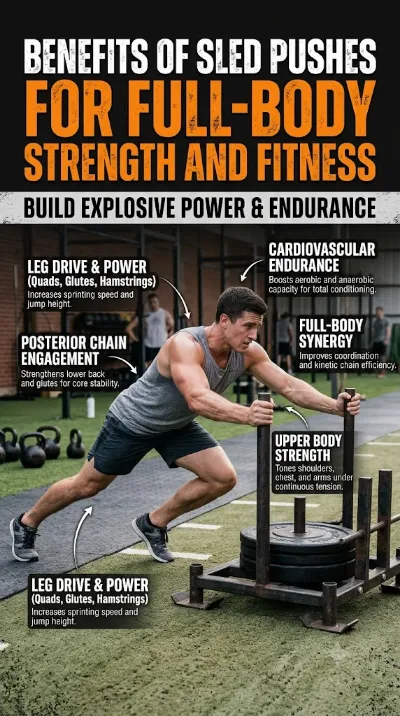
Driving a weighted sled across a floor—usually rubber or turf—is known as the “sled push.” To enhance resistance, you add weight plates. The weight of the load increases the required strength and power. Your entire body is involved in this exercise. The main driving force comes from your legs. Your core keeps you stable. Your arms and shoulders remain steady throughout.
The sled push is special because it blends strength and stamina. Unlike a conventional squat, you’re not just pushing weight vertically. Instead, you retain velocity over several pushes while driving horizontally.
Building Foundational Strength for Sled Pushing:
The main source of foundational strength is lower-body exercise. Because each leg drives the sled individually with each stride, concentrate on unilateral workouts.
Bulgarian split squats work your glutes and quadriceps, which are important for pulling a sled. They develop the strength required to move the sled ahead as a single-leg workout.
Your quads, hamstrings, glutes, calves, and core are all strengthened by box step-ups. For each stride to produce force, full hip and knee extension is essential.
Barbell back squats help you build strength and explosiveness by working your hamstrings, quadriceps, and glutes. They imitate the push-off movement required to generate momentum for a sled.
5 Sled Push Exercises For a Full-Body Burn:
Sled Fighting:
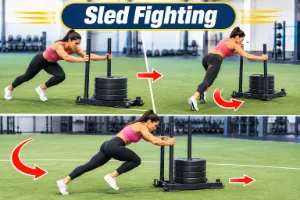
- How to proceed: Firstly, make sure you have enough room for this exercise. You’ll need a big square or rectangle to work in. For this workout, the heavier the weights you load onto your sled, the better.
- The sled should then be pushed forward a short distance using the bars, then turned 90 degrees and pushed forward once more. To push the sled in a square form, repeat this motion. For the most impact, it’s important to make sure every push is rapid and forceful. Consider it a sprint.
- Why we adore it: This is a program that will train your complete body, not just your legs. You will receive a tremendous workout because of the brief, powerful bursts of movement.
Bunny Hops:
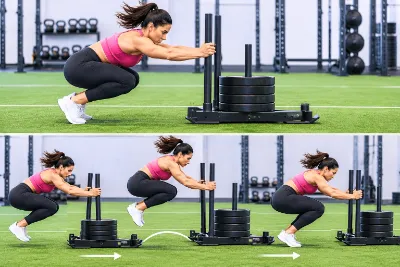
- How to proceed: For this workout, load the sled with a modest weight. Stretch your arms straight out and grasp the sled’s bars. Note: Make sure your back is straight and active to protect your back and core. Make sure the weight is in your quadriceps while crouching low with your feet hip-width apart.
- As the exercise’s name implies, you must push the sled while making quick hops or leaps forward—but not skips. During this workout, it’s important to keep your lower body in a firm frame; thus, accuracy is key. you get that additional burn, be sure you crouch down a bit as you land each leap. Reasons we adore it: This is a challenging workout! Bunny jumps on the sled work your legs and glutes simultaneously, and even a brief exercise can burn you.
Reverse Drag:
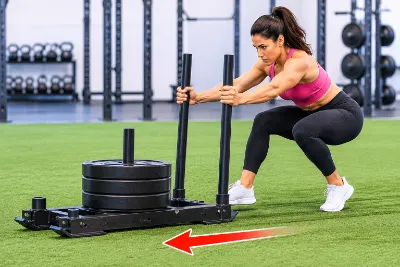
- How to do it: Let’s change things up and try some pulling! Load the sled with a medium amount of weight, squat low, grab the sled bars, and quickly drag the sled backward. The distance you travel will depend on your ability and the available space; don’t be afraid to start with short bursts and work your way up.
- To do this correctly, you must make sure that each workout burst lasts no more than 20 seconds. To make sure you never overdo it, take a break in between these little spurts.
- Why we adore it: This kind of workout will definitely leave you exhausted and perhaps even a bit sore because it crunches your hamstrings and other lower body muscles. This is a sled mainstay that will help you tone and develop your body over time, even though it will probably be very challenging at first.
Bear Crawl:
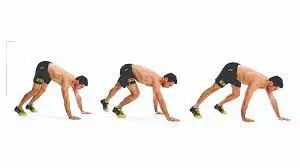
- How to proceed: This workout will definitely increase your strength, adding a new degree of difficulty to our collection of sled push exercises. To enhance the impact, load the sled onto a hefty object. Before you begin, you should fasten the sled to your body with a belt or vest.
- After you’re ready, go forward in a bear crawl stance. The duration of each burst of activity should be around 20 seconds. To make sure this one works, you don’t have to move quickly. Rather, concentrate on using your core muscles and making precise motions.
- Why we adore it: Any ability level may perform the bear crawl, which is a great full-body burning exercise. Adapt the weights to your own capabilities. You may raise your speed for a more strenuous workout as you get better at this one.
Rope-Slam-Pull:
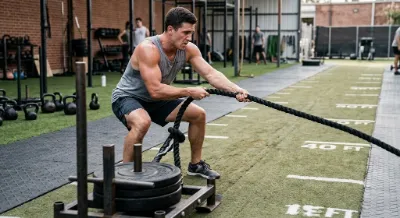
- How to do it: Take some ropes and fasten them to the sled’s base. Loop the ropes through the hook to make sure they are securely fastened. Put a medium amount of weight on the sled. Squat down a little, lean back, and grasp either end of the rope. After 10 to 15 seconds of single-arm waves, perform a sharp sled pull for around 50 feet. After a little pause, carry out the action once more.
What are the benefits of a sled push?
A full-body strength, power, and speed workout that improves performance, enhances speed, and burns calories is the sled push. Here are six reasons to include this exercise in your workout regimen.
Full-body workout:
Both the upper and lower body muscles will be used when the sled push is executed properly. More precisely, this activity will involve your:
- Quadriceps
- Gluteal Muscles
- Calves
- Hamstrings
- Abdominals
- Hip Flexors
- Chest
- Triceps
- Shoulders
Whether you add weight to the sled or not, all of these muscles will be used.
Calorie burn:
Prepare yourself for an intense, high-calorie workout if you have never pushed a weighted sled. You’ll burn more calories during your workout whether you do the sled push as part of a full-body circuit or just do a few reps of it at the end of your training.
Overall conditioning:
You may train for both power and speed by switching between heavy and light sled pushes.
You can exercise for both muscular and cardiovascular strength and endurance by loading the sled with moderate-to-heavy resistance. Lighten the load and push more quickly to train for speed.
You can also push the sled for a longer period of time at a slower rate without the weight. Your overall fitness and endurance may improve as a result.
Improved speed:
As part of a training regimen, pushing a weighted sled could increase speed.
The efficacy of loaded and unloaded sledge pushing for sprint training was examined by fifty high school athletes. The researchers found that pushing a sledge with any load is better than performing unlimited sledge pushes.
More precisely, they discovered that the biggest improvements in sprint performance over short distances may come from heavy loads.
The students were split into four groups by the researchers in order to ascertain this: three groups with different levels of resistance—light, moderate, and heavy—and one unresisted group. For eight weeks, each participant engaged in two sled-push workouts twice a week.
Gains were highest in the heavy group, despite improvements in all three of the resisted groups.
Functional training:
Even while you might not have to push a big sled while going about your daily business, you could occasionally need to push a heavy object (like pulling a stroller up a hill or moving a piece of furniture).
To maintain and stabilize a body position while pressing with your upper arms, you require static strength in your core muscles.
To avoid damage, you must also understand the right hip angles and how to protect your lower back.
Adaptability to all fitness levels:
Any level of fitness can use the sled push. Give up the weight and just push the sled if you’re new to working out or recovering from an injury. Weight should be added gradually as you gain strength.
By pushing the sled harder and faster, athletes and those with higher levels of fitness can push themselves.
How to incorporate a sled push into your fitness routine:
Your talent, degree of fitness, and fitness objectives will determine how you perform a sled push.
It’s safer to begin with your hands higher on the sled and in a more upright high-grip position if you’re new to the sled push. This puts your body at a 45-degree angle, which is safer and gentler on your lower back.
You can drop to a low-grip position, which puts your torso at a 90-degree angle, if you’re more skilled. Only once you’re comfortable with the basic form of the exercise should you try this posture.
How to use a sled push for speed:
- Put 25% of your maximum weight onto the sled. Select a weight that you can push for ten minutes with brief breaks if you are unaware of this. It is possible for novices to push the sled without any weight.
- Grab the poles with your hands in a high-grip stance while standing behind the sled.
- Start pushing the sled forward as quickly as you can while using your full legs by contracting your core muscles. As you push the sled forward, extend your knees and hips. Your foot stance should be similar to how you would naturally run.
- Push ten to twenty yards.
- Take a 30–60 second break.
- Rest for 30 to 60 seconds in between sets of four to six repetitions.
How to use a sled push for power:
- 70% of your maximum load is a reasonable starting point for loading the sled with a moderate-to-heavy load. Choose a weight that represents 70% of your body weight if you are unaware of this.
- Place your hands in a medium-to-high hold on the poles while standing behind the sled.
- Start pushing the sled forward as quickly as you can while using your full legs by contracting your core muscles. As you push the sled forward, extend your knees and hips. Your foot stance should be similar to how you would naturally run.
- Push ten to twenty-five yards.
- Take 30 to 60 seconds to rest.
- Rest for 30 to 60 seconds between sets of four to six repetitions.
How to use a sled push for endurance :
- 25% of your maximum load is a good place to start when loading the sled. Select a weight that you can push for ten minutes with brief breaks if you are unaware of this. It is possible for novices to push the sled without any weight.
- Grab the poles with your hands in a high-grip stance while standing behind the sled.
- Start pushing the sled with your entire legs while using your core muscles. As you push the sled forward, extend your knees and hips. Your foot stance should be similar to how you would naturally run. Since this isn’t about power or speed, you don’t have to press as hard as you can.
- For one minute, do this.
- Take a 30–60 second break.
- Do a 1-minute push followed by a 30-second rest five to ten times.
Precautions for the sled push:
The ability to modify the exercise to accommodate various fitness levels is one of the main advantages of the sled push. A sport-specific power movement can be converted into a general fitness workout by altering the grip and weight.
However, there are a few pointers and strategies to make this transfer secure and efficient:
- When pulling the sled, adopt a natural jogging stance.
- Throughout the exercise, maintain a neutral spine. Avoid rounding your back.
- Start with a small weight (or none at all) and concentrate on using your abdominal muscles if your core is weak.
- When pushing the sled, pay attention to your knee drive.
- Maximum acceleration is possible in the extended-arm position. For pushing the most weight, the bent-arm position is preferable.
- On a level surface, perform the push. The sled may be slid across a stretch of turf found in most gyms.
- Wear supportive shoes with enough traction at all times.
- In between sets, take a break.
- Stop what you’re doing and get advice from a physical therapist or personal trainer if you feel pain during the maneuver. They can verify that you are using proper form when performing the activity.
- If you have any problems with your knees, ankles, or lower back, get permission from your doctor or physical therapist.
Conclusion:
It takes perseverance, regular practice, and a desire to improve technique over time to master the sled push. The method that feels most natural should be used first. During training, practice each of the three possibilities. Make a commitment to the foundation of strength-building that enables powerful movement.
The sled push rewards commitment with real power development and the self-assurance that comes from successfully moving large objects.
FAQs:
What muscles does sled push work?
With increased calf activity and decreased activity in muscles close to the spine, sled pushes are about as effective as a barbell back squat for strengthening the quadriceps, hamstrings, and core. The muscles in the arms, shoulders, and chest are also worked by the sled push.
Is the sled push good?
Look no further than the sled push and pull for a workout that increases endurance, strengthens the entire body, and burns a ton of calories without taxing your joints. For good reason, these intense workouts are the foundation of fitness competitions like HYROX and sports training.
Is a sled better than squats?
The difference between their eccentric loading patterns gives heavy sled pushes an advantage over heavy squats. Only the concentric phase, which takes place during the push on the floor, requires the legs to exert resistance during a powerful sled push.
How heavy should sled pushes be?
This is what you’re really pushing (the sled is included in the weights): Open Women’s: 102 kg (225 lbs); Open Men’s: 152 kg (335 lbs); Pro Men’s: 202 kg (445 lbs)
Does sled push build speed?
Without the spinal strain of heavy barbell lifts, sled pushes help you develop strength and conditioning, drive through your hips, and engage your glutes and core. 2. Athletes who require increased speed and explosiveness: Heavy pushes increase thrust and acceleration.
Can you build big legs with sled push?
Sled pushes and pulls are a great way to increase the strength and power of your lower body. They work several muscle groups at once, such as the calves, quadriceps, hamstrings, and glutes. Additionally, this full-body exercise enhances general conditioning and cardiovascular endurance.
Are sled pushes bad for the knees?
If you’re healing from a lower-body muscle strain or an injury to your knee, ankle, or hip, sled pushes and pulls are excellent early in the rehabilitation process. Additionally, sleds are excellent for treating chronic knee pain.
What are the benefits of pushing a sled?
One of the easiest methods to increase your strength, power, fitness, and work capacity without overstressing your joints is through sled work. Sled pushes test your legs and core while developing lower-body strength, explosive power, and conditioning.
References:
- 5 sled push exercises and why we love them – TWL Journal – Train Without Limits. (2021, February 6). TWL Journal – Train Without Limits. https://blog.twl.com.au/5-sled-exercises-love/
- Lindberg, S. (2022, January 11). How to use a sled push to build power, speed, and endurance. Healthline. https://www.healthline.com/health/sled-push#bottom-line
- Harrison, A. G. (2017). The Bobsled Push start: Influence on race outcome and Push Athlete Talent identification and monitoring. Digital Commons – East Tennessee State University (East Tennessee State University). https://dc.etsu.edu/etd/3313