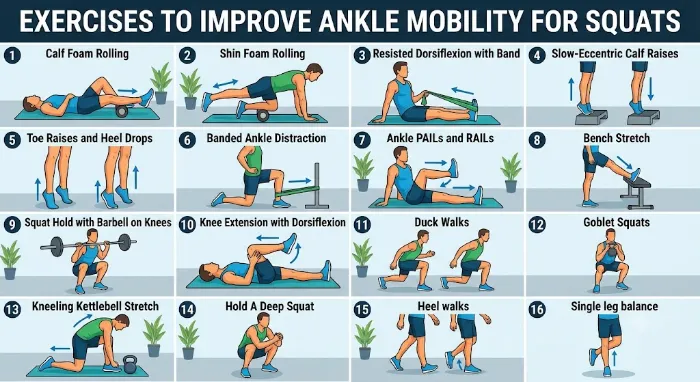
Ankle Mobility Exercises for Squatting
Introduction:
Ankle mobility is most likely a factor if your heels lift during squats, your knees collapse inward, your body falls too far forward, or you just can’t get deep enough without experiencing discomfort. It is one of the most common and frequently ignored squat performance limiters, yet with the right concentrated effort, it is highly manageable.
This guide explains how ankle restriction impacts your squat, how to assess your personal mobility, and the best workouts and routines to improve it.
Why Is Ankle Mobility So Important When Doing Squats?
Both your squat form and the amount of weight you can lift will increase with good ankle mobility.
Whether you’re a Professional athlete or a total beginner, one of the biggest obstacles to proper squatting technique is limited ankle mobility.
One of the many joints involved in squatting is the ankle, and how stable you are and how low you can squat depend on how well it flexes.
When performing a decent deep squat, you may feel as though you will rock back or possibly tumble backward if your ankles are rigid and lack range of motion.
You may get an idea of what someone with tight ankles looks like when they squat by picturing someone squatting while wearing ski shoes.
Your squat technique may be hampered by tight ankles, which could lead to a failed lift attempt or possibly put you at risk for injury.
Many lower body problems, including plantar fasciitis, Achilles tendon injuries, calf strains, shin splints, patellofemoral pain, IT band syndrome, and even ACL injuries, have been linked to ankle dorsiflexion.
How to Test Your Ankle Mobility:
Determine your current dorsiflexion range before beginning a mobility program. This provides you with a benchmark against which to assess your improvement and indicates whether ankle mobility is indeed your limiting problem.
The test from knee to wall:
- Facing a wall, place one foot about 10 cm away from the base.
- Aim to touch the wall with your kneecap as you drive your knee forward while keeping your heel level on the ground.
- Your dorsiflexion is sufficient for the majority of squat variations if your knee touches the wall with the foot ten centimeters away and the heel flat.
- If your knee is unable to touch the wall, bring your foot closer till it does, then take a measurement of the distance.
- On the opposite side, repeat and contrast
Analyzing the findings:
- Adequate dorsiflexion for the majority of squats when the foot touches the wall at a distance of ten centimeters or more
- Foot at 7 to 9 centimeters: a slight limitation that could interfere with Olympic lifting and deep squats
- Foot at less than 7 centimeters: a major limitation that is probably interfering with your squat technique
It’s crucial to test each side independently. The squat shifts to the more mobile side due to asymmetric ankle mobility, resulting in uneven loading and compensating tendencies that eventually raise the risk of injury.
Good ankle mobility supports:
- Improved stability and a lower chance of ankle sprains
- Better mechanics for walking and climbing stairs
- Deeper, safer lunges and squats
- Less stress on the hips and knees
- Improved postural control and balance
Warm-Up Before Ankle Mobility Work:
Warm up for one to two minutes before beginning the exercises:
- March in place — 20–30 seconds
- Ankle circles — 10 each direction
- Calf pump (heel up/down) — 15 reps
- Light calf stretch — 10–15 seconds
Warming up improves circulation, eases tense joints, and makes activities seem easier and more efficient.
Exercises To Improve Ankle Mobility For Squats:
The top exercises to increase your ankle mobility for squats are listed here. You won’t have any trouble reaching a deeper squat if you include a few of these in your warm-up.
Calf Foam Rolling:
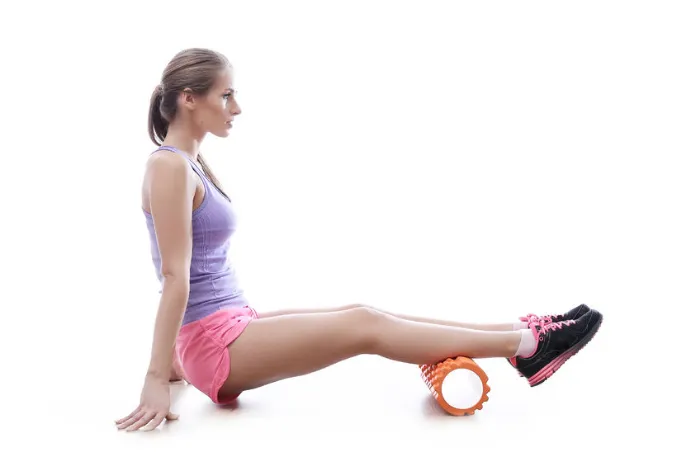
Try foam rolling on your calf muscles before squatting. Your ankle’s dorsiflexion mobility may be significantly impacted by the surrounding muscles and fascia.
Use a foam roller to break up the tissue around the heels and up the calf muscles.
Benefits:
- Loosens the calf muscles.
- Improves dorsiflexion mobility.
How to do it:
- Put a foam roller under your calf.
- Roll up to the top of your calf muscle from your heel.
- When you come across a tight region, consider applying extra pressure to help with it.
- To work into the site, flex and point your toe.
Shin Foam Rolling:

When utilizing a foam roller to improve ankle mobility, don’t overlook your shin. For tight ankles, working on the anterior tibialis muscle might be equally helpful.
While this is an excellent mobility exercise to do before your workout, I found that it can put a lot of pressure on your shins, which some gymgoers may find uncomfortable.
Benefits:
- Helps loosen your ankles.
- Works your anterior tibialis muscle.
How to do it:
- Roll upward while facing the floor and placing the roller at the base of the shin.
- The same is true while rolling the calf; you want to stretch and point the toe and take your time applying pressure to any tight or sensitive spots.
Resisted Dorsiflexion with Band:
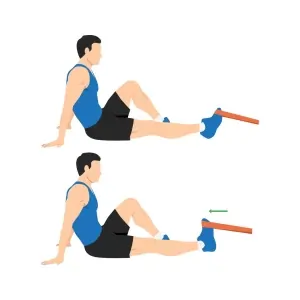
This is an excellent workout to strengthen ankles that are less prone to injury and to increase dorsiflexion.
This movement appeals to me because it can be done anywhere, even while you’re moving. I’ve done this exercise at a public park, my office, and even my hotel room.
Benefits:
- You can do it anywhere.
- Doesn’t require much equipment.
How to do it:
- Sitting on the floor, loop the band around a surface, then place the other end over your midfoot.
- Keep your leg out straight as you move back to provide strain to the band.
- Hold your foot flexed for ten to fifteen seconds.
- Change sides and repeat two or three more times.
Slow-Eccentric Calf Raises:

Before squatting, slow eccentric calf raise repetitions are an excellent dynamic warm-up. In addition to stretching out the calves to relieve any tension, this exercise will warm up the ankles for squats.
After an ankle injury, this exercise is also a great way to increase strength. I’ve previously utilized this movement with many people.
Benefits:
- Develops ankle strength.
- Improves ankle mobility.
- Releases calf tightness.
How to do it:
- Place the balls of your feet on an elevated surface and, without using it as support, allow one heel to gradually descend toward the floor while the other leg hangs down.
- When you sense a stretch, stop.
- To get back to the starting position, place the other foot on the platform and repeat.
Toe Raises and Heel Drops:
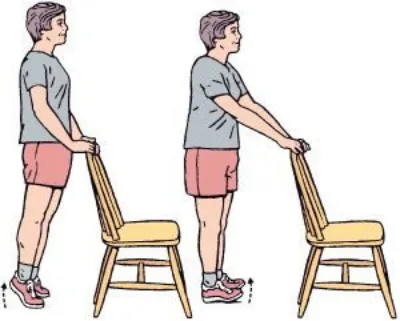
Ankle mobility exercises like the toe lift and heel drop—basically a calf raise exercise—will improve general mobility since they move the ankles through both plantar flexion and dorsiflexion.
After a lengthy riding workout, this exercise is excellent for strengthening and stretching the calf muscles.
Benefits:
- Strengthens the calf muscles.
- Great exercise for cyclists.
- You can do them anywhere.
How to do it:
- Press as far as you can into the balls of your feet and hold while standing on an elevated surface with your heels hanging over the edge.
- Next, lower your heels as far as they will go, then maintain this posture.
- Do this ten to twelve times.
Banded Ankle Distraction:
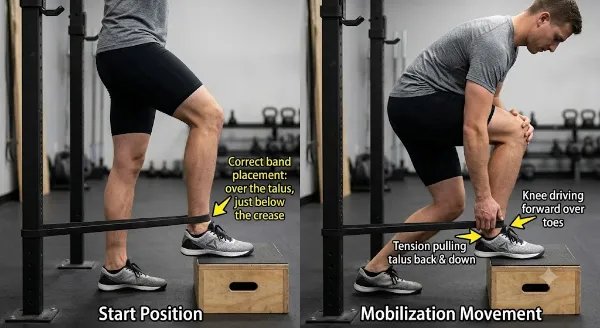
A popular and highly efficient method for improving ankle joint limitation is banded joint mobilization, which places a band under the ankle crease.
The objective is to draw the talus down and back while the tibia glides over the top of it; therefore, be careful not to place the band too high on the ankle.
The talus bone is locked in place by the band, which is why it works so well. If you feel a pinch at the front of your ankle, this is a great workout.
Benefits:
- Great for gym-goers on the move.
- Improves joint mobility and strength.
How to do it:
- Loop the other end of a resistance band around the top of your foot, which should be resting on the talus bone (the bone that makes up the lower part of your ankle), then fasten the band to a squat rack or pole.
- Hold the band firmly at your heel by applying strain to it.
- Put your knee as far over your big toe as you can, hold it there, and then go back to the starting position. Either the floor or an elevated platform, such as a small box, can be used for this.
Ankle PAILs and RAILs:
These stretches are an excellent way to warm up for squats and are an isometric loading method that doesn’t require any equipment.
You can perform this action anywhere since it doesn’t require any equipment. I’ve performed this exercise several times prior to jogging.
Benefits:
- Requires no equipment.
- Simple for all ability levels.
How to do it:
- While maintaining a level heel, bend your front ankle as much as you can in a lunge stance.
- Put pressure on your lead leg as you bend forward.
- Repeat on the other leg after you’ve relaxed.
Bench Stretch:

This movement uses a bench, as you have probably already guessed.
Because it focuses more on extending the calf’s soleus muscles than the gastrocnemius (the major calf muscle), the bench stretch is an excellent and easy method to increase dorsiflexion.
When squatting, the soleus muscle might restrict dorsiflexion. Tight calves and ankle mobility will both be improved by this stretch.
benefits:
- Stretches your calf muscles.
- You can do it in most locations.
How to do it:
- Stretch your back leg out behind you while placing one foot on a bench.
- Keeping your heel down, shift forward with your entire weight until your knee crosses the toe.
- To increase the stretch, place your hands on either side of the bench.
Squat Hold with Barbell on Knees:

A wonderful exercise to prime a deep squat position is the squat hold with a barbell on your knees, which you should perform just before you squat.
It will increase your hip flexibility in addition to your ankle mobility. One of my favorite mobility stretches for warming up for Olympic lifts and squats is this one.
benefits:
- Improves ankle and hip mobility.
- Great to warm up for Olympic lifts or squatting.
How to do it:
- Put yourself in a deep squat.
- The barbell should be positioned just above your knees.
- Maintain the posture for ten to twenty seconds.
- Relax and take a nap.
Knee Extension with Dorsiflexion:
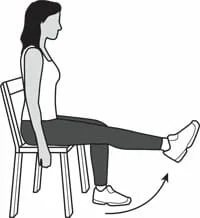
With increased resistance at the joint, this difficult yet effective exercise helps improve dorsiflexion.
This exercise appeals to me because it is appropriate for all skill levels and doesn’t require a lot of equipment.
benefits:
- Suitable for all abilities.
- You can do them anywhere.
How to do it:
- Put a kettlebell around the top of one foot while seated in a chair.
- Bzcq psvo posture nhuzlpdd while flexing your ankle.
- Make sure the kettlebell stays in place as you straighten your leg and return to the starting position.
- After ten repetitions, rotate to the other leg.
Duck Walks:

Duck walks, despite their humorous appearance, are an excellent dynamic exercise that helps the ankle joint move through a number of movements.
Doing this exercise with your training partner is both efficient and enjoyable. Everyone always laughed when I did this with my boot camp clients.
Benefits:
- Uses a wide range of motion.
- Fun to perform.
- Great for partner work.
How to do it:
- Put your other foot flat on the floor in front of you while kneeling on one knee.
- Push your whole weight into the front foot and drive your knee forward to begin moving forward. Then, use that momentum to switch sides.
- Make sure you have enough room to advance ten steps, then do this three or four times.
Goblet Squats:
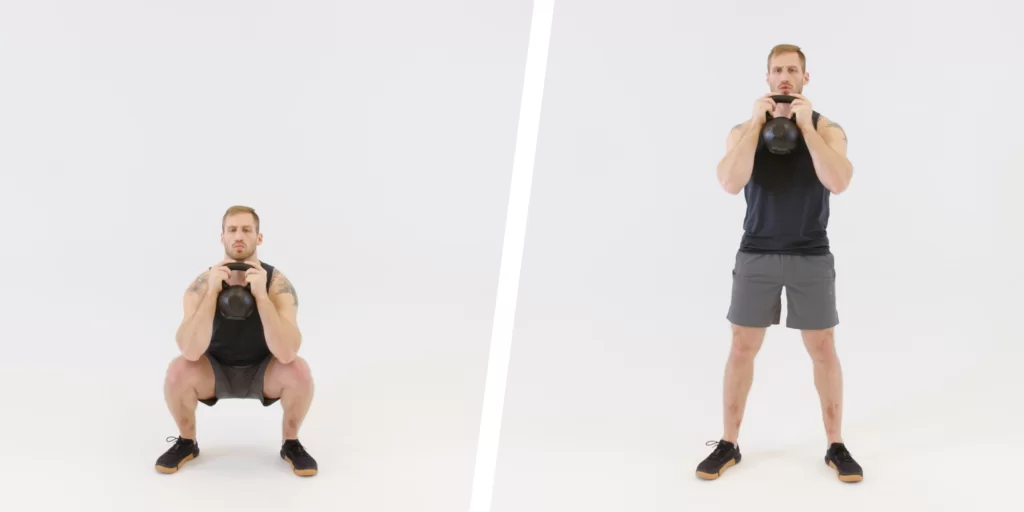
A very underrated exercise is the goblet squat.
This form of the squat helps patients with ankle constraints drop their hips into a deeper squat, which is great for increasing hip mobility and ankle mobility.
Since it’s simpler to do than the back squat, I frequently instruct beginners in this exercise.
benefits:
- It strengthens your entire lower body.
- Opens your hip joints.
How to do it:
- Stand with your feet shoulder-width apart while holding a kettlebell or dumbbell in front of your chest and near your torso.
- As much as you can, squat while maintaining a stable torso and hips. Because of the weight’s placement, it will be simpler for you to descend than a barbell squat.
- To make the movement better, pause in the bottom position.
Kneeling Kettlebell Stretch:
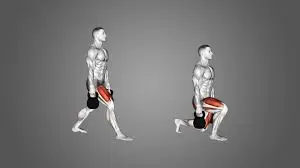
This exercise will help you perform a deep squat since it will simultaneously enhance your ankle dorsiflexion and stretch your calf.
The best part is that this exercise doesn’t require a lot of weight. A light kettlebell will work well for this.
All skill levels can perform this exercise, although I believe more experienced lifters will benefit most from it.
benefits:
- Stretches your calf muscles.
- Opens your hip joints.
How to do it:
- Bring one leg forward while maintaining a flat foot on the ground while kneeling on one knee on the ground.
- Put a relatively heavy kettlebell on your knee, shift your weight forward, and drive your knee forward as far as you can while maintaining a flat heel.
- After 30 seconds of holding, switch legs. Keep your heels firmly planted on the side you are stretching.
Hold A Deep Squat:

Simply sitting into deeper squats will help improve hip and ankle mobility if it’s preventing you from squatting the desired weight.
By gripping a weight plate and driving the knee over the toes with the weight, you can also perform the goblet squat stretch to experience a greater stretch in your ankles.
Try spending one to two minutes every day doing a deep squat.
benefits:
- Improves squat depth.
- Opens your hip joints.
- Increases ankle mobility.
How to do it:
- Put your feet hip-width apart.
- Bend your knees to squat as deeply as you can while keeping your spine neutral.
- For one to two minutes, maintain the squat position.
- Repeat after resting.
Heel walks:
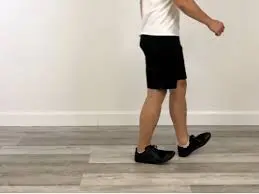
Heel walks are a great way to improve the strength and range of motion in your ankles. I’ve always thought it’s important to take as much care of your feet as you can. Your feet will take care of you if you take care of them.
Heel walks are an easy yet powerful exercise to build into your mobility regimen, in my opinion.
benefits:
- Doesn’t need any equipment.
- Simple to perform.
- Suitable for all abilities.
How to do it:
- Take a tall stance.
- Put your weight on your heels by lifting your toes off the ground.
- Walk slowly, keeping your toes off the ground.
- Take a certain number of steps.
- Relax and put your toes back down.
- Do it again.
Single-leg balance:
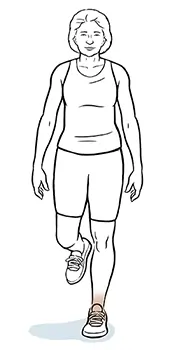
A simple yet efficient method for increasing ankle mobility and stability is single-leg balancing. It exercises every tiny muscle and tendon in your ankle as well as those around it.
This exercise, in my opinion, is excellent for athletes or anyone participating in sports since it strengthens the ankle and reduces the likelihood of “rolling” your ankle.
benefits:
- Simple yet effective.
- You can do it anywhere.
- Doesn’t require equipment.
How to do it:
- Place both feet hip-width apart while standing.
- Take one foot off the ground and maintain your balance.
- Hold for a specific amount of time.
- Unwind and switch sides.
- Do it again.
How Ankle Mobility Work Fixes Common Squat Problems:
- Inadequate dorsiflexion is the direct cause of heel raising. The heels remain flatter in deeper squat positions as ankle mobility increases with the knee-to-wall drill and banded distraction.
- Excessive forward lean: The body tilts forward to move the center of mass over the foot when the ankle is unable to dorsiflex sufficiently. Better dorsiflexion keeps the torso more upright by allowing the shin to move more easily.
- Knee cave: Ankle restriction causes the foot to pronate and the knee to follow inward as the body adapts for limited dorsiflexion, which is one of the many causes of knee cave, along with hip weakness. This compensating driver is eliminated by increasing ankle mobility.
- The most obvious result is the inability to reach depth. When the dorsiflexion range is larger, the hips may descend before the system achieves its maximum range of motion.
A Structured Ankle Mobility Routine for Squatters:
Pre-squat activation: Five minutes before each squat session
- 60 seconds for each leg of foam roll calves
- Ten ankle circles per foot in each direction
- Drill from knee to wall: 2 x 15 reps per side
- Distraction with banded ankles: 1 x 15 reps per side
Mobility exercise every day for eight to ten minutes:
- 90 seconds per leg for foam roll calves
- Exercise from knee to wall: 3 x 15 repetitions each side
- Banded ankle diversion: two sets of fifteen repetitions on each side
- 3 x 12 eccentric calf lowerers per leg
- Two 45-second ankle stretches on each side while half-kneeling
- Two 45-second deep squat holds with heel elevation
Conclusion:
Stiff ankles can be improved with a variety of drills and workouts at home and at the gym.
When it comes to honing your squat technique, please don’t overlook your ankles.
You can lift more weight if you have better technique. In addition to enhancing gym performance, stronger and more agile ankles will lower the risk of injuries.
FAQs:
How to improve mobility for squatting?
Ankle dorsiflexion, hip internal/external rotation, and thoracic spine extension are the three main target regions to increase squat mobility. You may develop a deeper, more comfortable squat by combining daily mobility exercises with active strength-at-length workouts.
Does squatting strengthen ankles?
While they mostly depend on ankle mobility (dorsiflexion) rather than strong, direct ankle resistance training, squats do assist in increasing ankle strength and stability.
Can weak ankles be strengthened?
It is possible to strengthen weak ankles. In order to prevent rolling, twisting, and recurrent sprains, targeted workouts increase the strength, flexibility, and balance of the muscles and tendons supporting the joint.
How can I improve my ankle mobility for pistol squats?
The most important mobility need for a pistol squat is good ankle dorsiflexion, which is the capacity of your shin to go forward over your foot as your heel remains level on the ground. Your heel will rise, or you will fall backward, if your ankle is rigid.
What is the best exercise for ankle mobility?
The best exercise for increasing total ankle mobility is the weight-bearing half-kneeling ankle lunge (dorsiflexion stretch).
How do I tell if I have poor ankle mobility?
The Knee-to-Wall Dorsiflexion Test or certain physical signs during daily activities might be used to determine whether you have poor ankle mobility.
References:
- Kirwin, L. (2025, December 29). 17 Best exercises to increase ankle mobility for squats. Garage Gym Pro. https://garagegympro.com/ankle-mobility-exercises-for-squats/
- The Complete Athlete Guide. (2026, June 1). Ankle mobility exercises for squats: Fix your depth and form with this routine. https://thecompleteathleteguide.com/ankle-mobility-exercises-for-squats/
- Log in ‹ Physical therapy Treatment and Exercise — WordPress. (n.d.). https://physical-therapy.us/wp-admin/post.php?post=94289&action=edit