Best Exercise to Correct the Neck Hump
Introduction
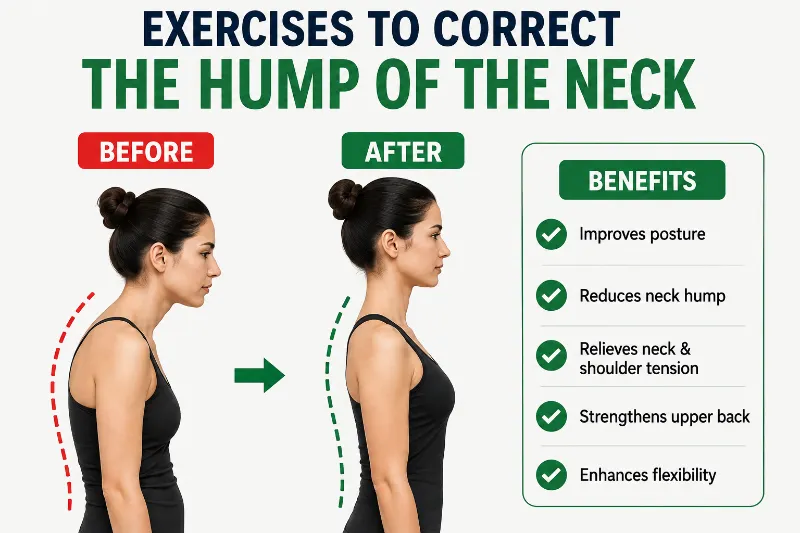
A common condition associated with shoulder and neck discomfort and stiffness is forward head posture, sometimes referred to as a “dowager’s hump,” “buffalo hump,” or “tech neck.” It is relatively common for older adults to have this aberrant curvature of the upper back, which can be caused by a variety of circumstances, including muscle weakness and postural changes.
The good news is that patients no longer have to deal with the condition’s chronic pain and cosmetic issues. Learn more about Dowager’s Hump, its possible causes, and some easy stretches that can help relieve related symptoms by reading on.
What Is a Dowager’s Hump?
Excessive forward curvature of the spine is known as kyphosis. Your spine’s natural curves support your posture and help you stand upright, but kyphosis can impair your posture and make standing difficult.
Apart from experiencing an upper back hump, you could also:
- Rounded shoulders
- Hamstring tightness
- Your shoulder blades and back may hurt or become stiff.
- Fatigue
- Migraines or headaches
What Causes a Dowager’s Hump?
Bone loss: An increased forward curve can result from a compression fracture. Because of the increased curvature of your upper back, you are forced to extend your neck more in order to view ahead. The upper back hump is caused by those two reasons. Because menopausal hormone fluctuations might raise a woman’s risk of osteoporosis, women are more likely to acquire a Dowager’s hump.
Degenerative alterations in your back. This is a gradual deterioration of your spine’s typical structure and functionality. The regular aging process is the most common cause of degenerative changes, which can range in severity. These alterations can also result from infections, tumors, and arthritis.
Underlying diseases of the ligaments or bones. Your spine’s form can also be altered by spinal infections, fractures, tumors, calcifications of the spinal ligaments, and other bony or ligamentous diseases.
Inherited issue: A less common occurrence is improper spinal formation before birth.
Scheuermann’s kyphosis: Teenagers exhibit this by developing a wedge-shaped spine rather than a rectangle.
Benefits of Neck Hump Reduction
1. Clearly Straighter Posture
In 6–10 weeks, regular training that focuses on the neck, upper back, and chest results in noticeable improvements in posture. Others frequently notice the change before you do.
2. Less Pain in the Upper Back and Neck
Most cases of neck hump are accompanied by chronic muscular strain in the neck and upper back. According to clinical observations and pain references, improving posture and strengthening the neck and upper-back muscles may help reduce musculoskeletal discomfort in some individuals.
3. Reduced Tension Headaches
Tension headaches are also caused by the forward head position that results in a neck hump. Headache frequency is significantly decreased when head-over-spine alignment is restored.
4. Enhanced Lung Capacity and Breathing
The lungs are compressed when one rolls forward. Many people see a measurable increase in energy and stamina after straightening their upper spine, which may support more efficient breathing
How to Begin Reducing Your Neck Hump?
What You Must Do First
10 to 15 minutes a day, a small area, and a resistance band if desired. No need for a gym. Session duration is not nearly as important as daily regularity.
Realistic Goal Setting
It often takes eight to twelve weeks for a noticeable change in the neck hump. It took a week for the hump to emerge, and it won’t go away in a week. Concentrate on regular practice every day.
Start with the Fundamentals
Chin tucks, shoulder rolls, and chest stretches every day; less screen time at desk level (raise your monitor); Maintain a comfortable sleeping position that keeps your neck and spine in a neutral alignment. Most neck humps caused by lifestyle are addressed by these four adjustments. Complementary cervical spine exercises are included in our cervical pain exercise guide.
The Best Exercise to Correct the Neck Hump
Chin Tuck:
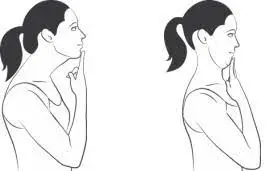
How to get started:
- Sit upright on a firm chair, feet flat on the ground.
- Maintain a straight look and relaxed shoulders.
- Draw your chin straight back, as though creating a “double chin,” without tipping your head up or down.
- After holding for two to five seconds, gradually return to the starting position.
- 3 sets × 10 repetitions.
Benefit: The most crucial exercise for reducing the neck hump.
Wall Angels:
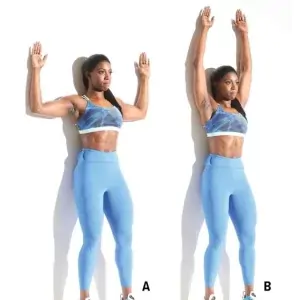
How to get started:
- Stand upright with your back pressed against a wall and your feet comfortably apart.
- Hold your hands at shoulder height and press the backs of your arms and hands against the wall.
- Lift your arms upward toward the ceiling.
- Make sure not to shrug your shoulders and keep your arms in contact with the wall as you move.
- To return to the starting position, slowly slide your arms down the wall.
- 3 sets × 10 repetitions.
Benefits include better posture and shoulder mobility.
Shoulder blade squeeze
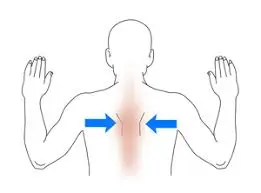
How to get started:
- To begin, place your elbows at your sides and bend them to a 90-degree angle.
- Squeeze your shoulder blades together and move your shoulders and elbows back.
- Return to your starting posture with your shoulders relaxed.
- 3 sets × 10–12 repetitions.
Benefits: Strengthens the mid-traps and rhomboids, helping align the upper back.
Bhujangasana (Cobra Pose)
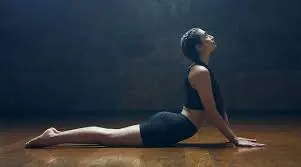
How to get started:
- Lie down on your stomach in a comfortable position.
- It might be easier to do this on a yoga mat or a soft surface.
- Position your hands on the floor, placed beside your chest.
- Press down through your hands to extend your arms and lift your shoulders and head upward.
- Hold this position for a few seconds, making sure your lower body and core remain relaxed.
- Slowly lower your arms back down to return your chest to the floor.
- Hold this relaxed position for 15 to 30 seconds and repeat this movement 2 to 3 times.
Benefits: relieving tense muscles, especially those in the shoulders, neck, and back
Doorway Chest Stretch:
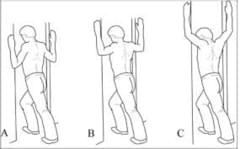
How to get started:
- Start by bending your elbows and placing each forearm on one side of the doorframe while standing in a doorway. You want your elbows to be around chest height.
- Move your hips and torso forward while keeping your forearms in position by stepping one foot into the doorway.
- Make an effort to extend your arms and chest.
- Reposition your chest and hips to ease out of the stretch.
- Hold for 20–30 seconds × 2–3 repetitions.
Benefits: Reposition your chest and hips to ease out of the stretch.
Pull-Apart Resistance Band:
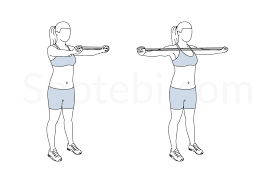
How to get started:
- Holding a band in both hands with some slack in it, stand up with your arms out in front of you at chest height. Make sure your palms are pointing down.
- As you extend your arms to your sides, keep them straight.
- Avoid raising your shoulders in the direction of your ears and maintain your arms at chest height.
- 3 sets of 12–15 repetitions.
Benefit: Enhanced shoulder mobility and protection for the back, shoulders, and upper back from bullets.
Levator scapulae stretch:
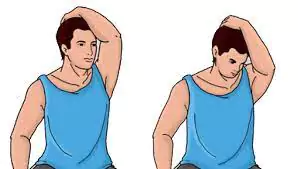
How to get started:
- Hold the edge of your chair gently with one hand while sitting upright.
- Look down at that armpit after bringing your eyes halfway to your opposite shoulder.
- To increase the stretch’s pressure, place your opposing hand on your head.
- Repeat on the other side after returning to the middle.
- Hold for 20–30 seconds on each side × 2–3 repetitions.
Benefit: Enhances posture by decreasing forward head and rounded shoulder positions.
Usual Problems in Neck Hump Reduction
1. Considering it just a “Fat” issue
The majority of neck humps are caused by a forward head, rounded shoulders, weak upper back, and some fat buildup. The hump cannot be resolved by focusing just on fat loss. Working on your posture is crucial.
2. Extending Without Developing Strength
The hump cannot be fixed by just extending the chest and neck, although it can momentarily release stress. Long-lasting transformation is achieved by strengthening the upper back.
3. Overcoming Severe Pain
When performing stretches or chin tucks, sharp discomfort is a warning sign to quit. Instead of going into pain, go to the brink of ease.
4. Inconsistency
Nothing comes from a few sessions every month. Change happens every 10 to 15 minutes. Frequency, not duration, is what causes the neck to react.
Who Needs to Minimize Neck Humps?
Tech Users and Desk Workers
The most common cause of the modern neck hump is forward head posture from displays. This guide’s activities specifically address the reason.
Perimenopausal Women and Beyond
The formation of a neck hump may be influenced by hormonal changes. Lifestyle modifications address both drivers when combined with posture exercises.
Senior Citizens
A neck hump is a common symptom of age-related kyphosis, or forward spinal curvature. If you have osteoporosis or substantial changes to your spine, always see a doctor before beginning any new exercises.
Individuals with persistent neck or upper back pain
Since they have the same mechanical source, reducing the neck hump typically results in less discomfort.
FAQs
How much time does it take to eliminate rounded shoulders?
Your lifestyle, general health, and the severity of your rounded shoulders will all affect how long it takes to get rid of them. A timetable tailored to your situation could be provided by a medical expert or physical therapist.
How Much Time Is Needed to Get Rid of a Neck Hump?
Most patients see early improvements in their posture within four to six weeks. It typically takes 10–14 weeks of regular daily practice to see a noticeable reduction in hump size.
Should I Take My Neck Hump to the Doctor?
Yes, if you’re under 50 and don’t have a clear explanation for your posture, the hump is uncomfortable, increasing quickly, or just started. Certain neck humps indicate underlying health issues.
References:
- Yorkville SportsMed. (2026). The 6 Best Stretches & Exercises to Correct Dowager’s Hump | Physiotherapists in Toronto | Yorkville Sports Medicine Clinic. Physiotherapists in Toronto | Yorkville Sports Medicine Clinic. https://www.yorkvillesportsmed.com/blog/the-6-best-stretches-exercises-to-correct-dowagers-hum
- (n.d.). Checking your browser… habuild.in. https://habuild.in/habitology/yoga/how-to-reduce-neck-hump/
- Cleveland Clinic. (2023). Dowager’s Hump: What It Is and How To Get Rid of It. Cleveland Clinic. https://health.clevelandclinic.org/how-you-can-fix-a-dowagers-hump-prevention-tips