Synergy Pattern
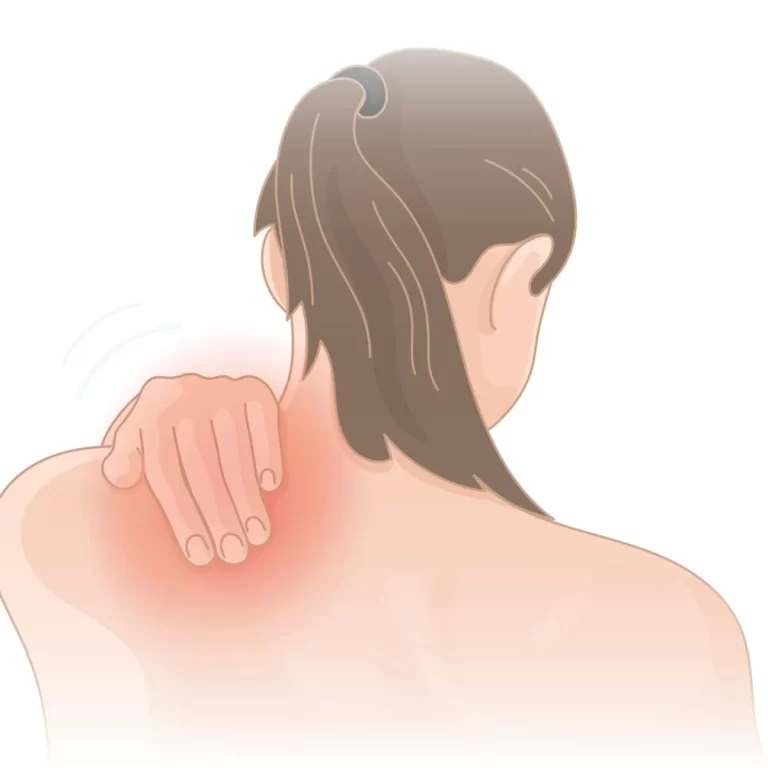
Does your shoulder rise when you move your arm? We refer to this as a synergistic movement. This kind of movement is extremely typical in the initial phases of stroke healing.
The word “synergy” comes from a Greek word that means “collaborating.” Thus, the term “synergistic movement” describes a movement in which several muscles cooperate to carry out a particular action. Synergistic movements happen after a stroke when you plan to execute a certain movement but wind up executing other motions. For instance, attempting to move your injured elbow may also cause motions in your hands and shoulders. During stroke healing, movement is a positive indicator, but synergistic movement is not the best.
Don’t worry if this phenomenon is frustrating you. This post will walk you through the reasons for synergistic movement and show you how to break free from this undesirable movement pattern.
Overview
Although managing flexion synergy patterns following a stroke can be fairly uncomfortable, it is quite encouraging if they show any progress toward recovery.
Synergistic movements are produced when many muscular contractions are triggered simultaneously. For example, you may feel a tightness in your elbow when you try to move your shoulder.
People who have experienced a stroke frequently exhibit the phenomenon known as flexion synergy patterns. The way that certain muscle groups in the body “synergize” with one another to move the affected limb is described by these patterns.
Maintaining a thorough awareness of flexion synergy patterns may be crucial for helping stroke patients on their path to recovery.
What are Synergy Patterns, exactly?
Coordinated movements that happen when many muscle groups are used at once are referred to as synergistic motions. We constantly use synergistic motions as a result. For instance, walking requires the utilization of four distinct muscle synergies in healthy people. These all take place at various phases in a person’s gait, or walking, pattern, and are crucial for coordinating the motions needed for walking.
Synergistic movements following a stroke, however, often relate to aberrant synergies that worsen bad movement patterns rather than good motor synergies. When a stroke impairs the part of the brain that controls muscular activity, your brain is unable to effectively communicate with your muscles. As a result, aberrant synergistic movement and other motor issues may arise.
When trying to elevate just their arm, a stroke victim exhibiting synergy could, for instance, hike their shoulder. If left untreated, this synergistic movement can result in poor movement patterns and other issues, including chronic discomfort.
Synergistic Movement Types Following Strokes
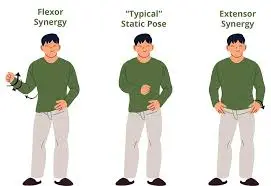
Following a stroke, there are two primary types of synergistic movement known as flexor and extensor synergies.
The shoulder, elbow, wrist, and finger muscles in the arms are connected by these synergies. Because the aberrant synergistic movement disrupts the regular muscle synergies utilized for these tasks, it may be difficult to perform everyday living activities like eating and dressing.
An example of synergistic movement in the upper extremities
Flexor synergy in the arms includes:
- Abduction of the shoulder (lifting the arm sideways)
- Elbow flexion in a supinated position, with the palm pointing up
- Flexion of the wrist and fingers
The arm’s extensor synergy includes a variety of opposing motions, such as:
Adduction of the shoulder (stretching inward)
Pronation of the elbows (palm facing down)
Finger flexion and wrist extension (these positions may differ)
The legs also exhibit flexor and extensor synergy. This synergy may cause balance issues when standing and walking. People may have a limp or other irregular gait because flexor and extensor synergies are only felt on the affected side of the body.
The leg’s flexor synergy includes external rotation, abduction, and flexion of the hip; knee flexion; and ankle dorsiflexion and eversion (foot pointed upwards and outward); on the other hand, the leg’s extensor synergy includes: internal rotation, adduction, and extension of the hip; knee extension; and ankle extension and inversion (foot pointed downward and inward). Although synergistic movement following a stroke may present many difficulties, it can also mark the start of a survivor’s road to recovery.
In the Initial Phases of Stroke Recovery, the Synergistic Movement
Synergistic movement is an indication of possible progress even if it may appear to be a frustrating issue. This is explained by the Brunnstrom phases of stroke recovery. This structure consists of seven stages:
- First Stage: Flaccidity
- Stage 2: The appearance of spasticity
- Phase Three: Enhanced spasticity
- Phase Four: Reduced spasticity
- Stage 5: The resumption of complex movement
- Stage 6: The loss of spasticity
- Stage 7: Return to normal function
Survivors can begin at any point of stroke recovery, depending on how severe their stroke was.
In the second stage of the Brunnstrom framework, spasticity—a disorder that results in stiff, tight muscles—and synergistic movement often manifest. When there is no innervation in the impacted muscles, the first stage, called flaccidity, or post-stroke, develops.
When a survivor moves from stage 1 to stage 2 of the Brunnstrom framework, the movement begins to return to the affected muscles—especially synergistic movement returns.
Although this unintended movement pattern requires more therapy, it is a sign of improvement. It indicates that the affected muscles are beginning to “wake up,” allowing the survivor to go through the healing phases.
Until stage 5 of the Brunnstrom framework, when survivors can execute more intricate, coordinated motions again, the synergistic movement continues.
Let’s now talk about moving past synergistic movement to a more thorough stroke rehabilitation.
Unlinking Synergistic Movement
Physical and occupational therapy can assist in retraining your brain to move your muscles smoothly and without creating extraneous movements when synergistic movement takes place. Consistently performing stroke recovery activities is the most effective method of brain retraining.
The greatest treatment for post-stroke movement problems is repetition. You strengthen the neural connections in your brain that are in charge of that job whenever you regularly do repetitive motions, often known as massed practice. Because the neuronal connections have been reinforced by repetition, behaviors become automatic. The brain
may reorganize itself to recover after a stroke thanks to a process known as neuroplasticity, which involves forging and strengthening neuronal connections.
The neurological connections that govern your affected arm begin to get stronger when you perform arm workouts regularly. However, when synergistic action causes unexpected muscles to move, like your shoulder going up, it can be challenging to do these exercises effectively.
You may worry about picking up bad movement patterns as a result of this. We’ll then go over why, if you give it your all every time you work out, you don’t have to worry about it.
What Is the Significance of Flexion Synergy Patterns in Stroke Recovery?
Patterns of Flexion Synergy Following a Stroke
Following a stroke, flexion synergy patterns comprise three motions:
- Rotation of the shoulders to the outer elbow bending
- Wrist supination
- Put differently, anytime you move the affected arm, your wrist rotates till your palm faces up, your shoulder rises, and your elbow contracts. This can happen even when you don’t move, such as when you sneeze or cough.
Even while these motions might be uncomfortable, they also show that your stroke healing is going well.
Flexion Synergy Pattern and Stroke Recovery Stages
In Brunnstrom stages two and three of stroke recovery, flexion synergy patterns emerge.
In the early Brunnstrom stage, the muscles are weak. This suggests that your muscles are briefly paralyzed because messages from your brain are not getting to them.
But during stages two and three, the muscles start to “wake up” as the brain and muscles re-establish their connection. At that point, synergistic patterns might emerge.
Your brain uses flexion synergy patterns to strengthen muscle control. Although this is a long process, it is possible to expedite it.
Patterns of Flexor and Extensor Synergy
Grasp and treating motor deficits after neurological damage requires a grasp of the core ideas of flexor synergy and extensor synergy patterns. The distinctions between flexor and extensor synergy patterns, their effects on motor control, and methods for incorporating them into rehabilitation therapies are all covered in this extensive book.
Flexor synergy patterns, which are frequently seen in diseases like stroke or spinal cord injury, usually entail the synchronized activation of muscles that flex or bend joints.
These patterns are typified by involuntary movements such as hip and knee flexion as well as flexion of the elbow, wrist, and fingers. As they create therapies to address muscle tone, range of motion, and functional movement restrictions linked to these patterns, rehabilitation practitioners must have a thorough understanding of flexor synergy patterns.
On the other hand, extensor synergy patterns, which are frequently seen in neurological disorders like cerebral palsy or traumatic brain injury, entail the coordinated activation of muscles that lengthen or straighten joints. These patterns frequently show up as involuntary motions including hip and knee extension, as well as extension of the elbow, wrist, and fingers. In order to increase functional mobility and independence, rehabilitation techniques that target extensor synergy patterns seek to treat muscular weakness, spasticity, and coordination deficiencies.
It takes a multifaceted strategy that takes into account the underlying neurological mechanisms of flexor and extensor synergy patterns to include them in therapy. To treat muscle imbalances, encourage motor recovery, and improve movement control, physical and occupational therapists employ a range of strategies, such as neuromuscular reeducation, therapeutic exercises, and functional task training.
Furthermore, increasing independence in everyday tasks and enabling movement patterns may be aided by the use of orthotic therapies and assistive equipment.
Rehabilitation specialists can customize interventions to address particular motor impairments and functional limitations by comprehending the nuances of flexor and extensor synergy patterns. This will ultimately enable people to meet their rehabilitation objectives and improve their quality of life.
Individuals with neurological injuries can restore their freedom in everyday activities and optimize their chances of recovery with a personalized and cooperative rehabilitation strategy.
How to Get Rid of Movement Patterns That Work Together
The majority of therapists would concur that performing rehab exercises improperly—that is, with synergistic movement patterns—is not ideal, as it may exacerbate these unfavorable movement patterns.
But when a stroke victim is unable to move at all due to extreme spasticity and synergistic movement, it is evident that any movement, as long as you are always doing your hardest and paying attention to proper form, is preferable to none at all.
You will continue to support neuroplasticity and improve as long as you make an effort to exercise with proper form each time.
Because your therapist may utilize manual treatment techniques to assist your limb(s) with appropriate form throughout each repetition, you will benefit most from completing your exercises directly with them at this stage of rehabilitation. Instead of encouraging aberrant synergistic patterns, this will support appropriate movement patterns.
Comprehending Post-Stroke Synergistic Movement
When you attempt to move one bodily component, like your arm, and wind up moving others, such as your arm, hand, and shoulder, this is known as a synergistic movement.
This can be a frustrating habit, but if therapy is being sought, it may be an indication of recovery.
Therapeutic rehab activities might help you reduce synergistic movement patterns. By repeating these motions, you may “separate” your muscle movements and rewire your brain. You will strive to be able to execute precise, well-coordinated motions with constant practice.
“Synergy patterns” describe how the body’s several muscle groups work together to produce movement, a process commonly referred to as “synergizing.” Their coordinated action of several muscle groups, as opposed to the activity of individual muscle groups functioning alone, sets them apart from the isolated activity of individual muscle groups.
In other words, a synergy pattern occurs when several muscles work together to do a certain motion rather than each muscle performing the movement alone.
Synergy patterns can be observed in healthy individuals as well as those who have experienced a stroke. This is because the body naturally uses specific muscle groups in conjunction with other muscle groups to achieve specific actions.
Depending on the specific muscle groups collaborating, there are a variety of synergy patterns that might exist, including flexion synergy patterns (which were previously discussed), extension synergy patterns, and other types of synergy patterns.
Handling Patterns of Flexion Synergy After a Stroke
The majority of therapists concur that doing rehabilitation exercises incorrectly—that is, using synergistic movement patterns—is undesirable, as it may reinforce these undesirable movement patterns.
Any movement is better than none at all when you’re giving it your best and focusing on the proper form every time, even if severe spasticity and synergistic movement prevent a stroke survivor from moving at all.
You will continue to encourage neuroplasticity and get better as long as you try your utmost to use the appropriate form each time you work out.
Your brain can create new neural connections that will enable muscle groups to interact once again the more you train your damaged muscles.
Naturally, this might be challenging, especially if the motions are unusual. Therefore, your best option is to collaborate with a physical therapist to determine the best course of action.
You should eventually be able to achieve normal mobility and function, or as close to it as is practical, if you keep up your activity.
The following exercises can assist you in overcoming patterns of flexion synergy:
Exercise in Passivity
Exercises for passive range of motion may help you maintain your range of motion and improve your ability to manage your muscles. During passive exercises, the therapist works your muscles on your behalf.
Having someone else move is sufficient to stimulate the brain and rekindle the neuronal networks that enable movement, even if you aren’t doing it yourself.
Sensory Activities
Patterns of Flexion Synergy Following a Stroke
In synergistic motions, sensory stimulation is essential. It is responsible for instructing your muscles on where and how to move.
Muscle proprioceptive receptors let the brain identify the location of your joints in space. As a result, the brain can decide which muscles to use to move.
Following a stroke, the sensation may be altered. Your mobility will increase as a result of sensory exercises that help you regain your senses.
Exercises for Active Range of Motion
Exercises including active range of motion help to enhance joint function. Your joints’ range of motion is the amount of movement they can make in different directions. You can move each joint through its full range of motion with the help of these exercises.
Movement can help to improve strength and balance, reduce pain, and preserve joint flexibility.
Once more, when you first start, you probably won’t be able to do these things flawlessly.
That’s fantastic; just keep practicing and try your hardest.
The Brunnstrom method
Overview
Clinicians frequently employ the Brunnstrom method as a movement therapy technique.
This method places a strong emphasis on the synergistic pattern of spastic muscles during the different phases of stroke patients’ rehabilitation. With this method, no specific training is offered.
History
This method was created in the 1960s by Swedish physical therapist Signe Brunnstrom.
Several conventional neurophysiological theories of motor control served as the foundation for her research on hemiplegia. She experimented with different verbal and muscular responses to each treatment, based on patient observations. Although there are several rehabilitation techniques for stroke patients, there isn’t much data to support them.
Presumptions
To establish the fundamentals of movement strategy, Brunnstrom created assumptions about the motor control and responses of stroke patients. They are as follows:
Because reflexes are used to assist and acquire purposeful movements, recovery from a stroke appears to result in development in reverse. In normal motor development, reflexes are converted into purposeful movements. According to Brunnstrom, no sensible training technique should be abandoned and declared “It’s possible that a reflex-based subcortical motion synergy could act as a wedge to teach a restricted quantity of deliberate movement. To elicit desirable motion or tone changes, proprioceptive and exteroceptive inputs might be used.
Following a stroke, voluntary movement recovery progresses step-by-step from mass patterns to distinct voluntary motions. Limb synergies are the term for the standardized motions.
Repetition is crucial for learned movements.
Learning is improved by practice in the setting of ADLs.
Fundamentals
The following are the tenets of movement therapy:
- From reflexes to voluntary to functional motions, treatment advances in a developmental cycle.
- In the absence of motion, reflexes, related responses, and proprioceptive/exteroceptive cues can be used to induce muscular tension and promote movement.
- Semi-voluntary movement results from the combination of reflex and related reactions with intentional effort, which provides sensory input and enjoyment.
- A variety of stimuli are used to help trigger movement. While tactile stimuli only allow muscles to move to the stimulated spot, resistance (proprioceptive stimuli) encourages impulses to propagate to neighboring muscles to elicit an accompanying reflex.
- If voluntary effort is made, the patient is requested to hold (isometric) a response. He is instructed to contract eccentrically (controlled lengthening) and concentrically (controlled shortening) if at all feasible.
- Every session emphasizes movement reversal, even if just a partial movement is feasible.
- As soon as the patient demonstrates voluntary control, facilitation measures are discontinued. Tactile stimuli are removed last because responses to exteroceptive stimuli are the least stereotyped. After stage 3, no rudimentary reflexes are employed.
- Similar ADLs are recommended to be performed, with a greater emphasis on voluntary mobility. Once elicited, correct movement should be performed and repeated.
Assessment
Evaluation is carried out to determine the best course of therapy and assess the condition’s prognosis. It involves figuring out the following:
Sensory analysis
Assesses the patient’s non-visual capacity to detect touch and movement. The results advise the therapist to utilize visual feedback to make up for lost feelings or assist in choosing the facilitation strategy to employ.
Degree of voluntary control recovery
Brunnstrom enumerated recovery phases for the hand, lower limbs, and upper extremities.
Tonic reflexes’ impact on the patient’s mobility
In the early stages of therapy, tonic reflexes should be evaluated in order to start movement when none is present. Asymmetrical and symmetrical tonic neck reflexes, tonic labyrinthine reflexes, and lumbar reflexes are the most common primordial reflexes.
The impact of related responses on the patient’s mobility
Involuntary movement or a programmed reflexive tone rise in the muscles that should be in opposition to the movement are examples of associated responses. When an attempt is made in the affected extremity or other unaffected extremities are resisted, these responses are observed in the affected extremities. To choose the best facilitation technique, they are assessed.
The following are associated responses observed in stroke patients:
- Flexor Synergy
- The Extensor Synergy
- Raimstein’s Phenomenon (the affected leg moves in the same way when the noninvolved limb resists hip abduction or adduction)
- The involved extremity extends when the noninvolved leg is resistant to flexion, and the involved extremity flexes when the noninvolved side is resistant to extension.
- The engaged hand has a grab reflex when the noninvolved hand is resisted.
- Flexor movement or tone may be elicited in the involved arm when the patient attempts to flex the leg or leg flexion is resisted. This reaction is called homolateral synkinesis.
- Souque’s Phenomenon – Increased tone of the involved arm above horizontal evokes an extension and abduction of fingers.
When the patient tries to flex the leg or when leg flexion is prevented, flexor action or tone may be evoked in the affected arm. We refer to this response as homolateral synkinesis.
Souque’s Phenomenon is when the affected arm’s tone rises above horizontal, causing the fingers to extend and abduct.
Required synergies
When spasticity manifests in medicine, as it does after a stroke, obligatory synergies occur. Obligatory synergies are aberrant and stereotyped patterns that occur across several joints. They impact both the upper and lower extremities and are referred to as either flexion or extension synergies.
A patient who experiences these patterns cannot move a limb segment independently of the pattern. This disrupts the regular activities of daily life. However, some elements of the required synergy patterns can be strategically employed to enhance the function of the individual’s range of motion. Therefore, while choosing which muscle groups to stretch at particular points during recuperation, careful consideration should be given. When a patient attempts a minimum voluntary movement or when their reflexes are activated, obligatory synergy patterns are seen.
The upper extremity flexion synergy includes wrist and finger flexion, elbow flexion, forearm supination, shoulder abduction and external rotation, and scapular retraction and elevation.
Scapular protraction, shoulder adduction and internal rotation, elbow extension, forearm pronation, and wrist and finger flexion are all components of the upper extremity extension synergy.
Hip flexion, abduction and external rotation, knee flexion, ankle dorsiflexion and inversion, and toe dorsiflexion are all included in the lower extremity flexion synergy. Hip extension, adduction and internal rotation, knee extension, ankle plantar flexion and inversion, and toe plantar flexion are all components of the lower extremity extension synergy.
The lattisimus dorsi, teres major, serratus anterior, finger extensors, and ankle evertors are among the muscles that are typically not implicated in these synergy patterns.
Conclusion
You can simultaneously move several arm segments with flexion synergy patterns. Although they are uncomfortable, they indicate that there is improved communication between your brain and muscles.
Fortunately, with consistent use of therapeutic rehab exercises, flexion synergy tendencies may be corrected. The purpose of these workouts is to isolate the relevant muscle group and retrain the brain.
With enough repetition, you might be able to regain voluntary control over your muscles and move your arm fluidly.
FAQs
What is a synergistic pattern?
Overview. Clinical observations show that throughout the recovery phase, the affected limbs of stroke patients have aberrant synergy patterns. The term “synergy pattern” describes how muscles or joints work together to produce certain motions.
What is the difference between spasticity and synergy patterns?
Neurolutions for Stroke, Spasticity, and Flexor Synergy
Synergy frequently resembles an arm or leg being pushed out into extension away from the body or pulled in towards the body in flexion. The term “flexor synergy,” often referred to as “spasticity,” describes how a muscle “draws” or “pulls in,” which causes a limb’s muscles to seem rigid, taut, or immobile.
What is synergy in stroke?
Following a stroke, individuals may experience abnormal synergy, a motor disability. Certain individuals experience a loss of autonomous control over certain muscle groups, which leads to linked joint motions that are frequently unsuitable for the intended purpose. We refer to these coordinated motions as aberrant synergy.
What are the PNF synergy patterns?
PNF patterning, which is divided into D1 (Diagonal 1) and D2 (Diagonal 2) patterns, is applied to the upper and lower limbs. The shoulder, elbow, wrist, and fingers are all included in the upper extremity pattern. The hip, knee, ankle, and toes are all included in the lower extremity pattern.
What are the 7 stages of stroke recovery?
According to Saebo, the Brunnstrom Stages of Stroke Recovery
The Brunnstrom Stroke Recovery Stages
The Brunnstrom Approach: What Is It?
Phase One: Fluidity.
Step 2: Handling the Spasticity Appearance.
Increased Spasticity in Stage 3.
Stage 4: Spasticity has decreased.
Stage 5: Combinations of Complex Movements.
Spasticity disappears in stage six.
Stage 7: Returns to Normal Function.
References
- Buffalo Occupational Therapy. (2024, May 25). Flexor Synergy vs Extensor Synergy Patterns. Buffalo Occupational Therapy – Occupational Therapy Specialized in Alzheimer’s Disease and Neurodegenerative Conditions of Brain and Body.
- https://www.buffalooccupationaltherapy.com/the-occupational-therapy-store/diagnosis-handouts/flexor-synergy-vs-extensor-synergy-patterns/?
- srsltid=AfmBOoqFdhtxppbhWNadKja6GJatnZoQq-qwOpjqZDNDUNh4HkIrIwu0
- Wikipedia contributors. (2023, December 9). Obligatory synergies. Wikipedia.
- https://en.wikipedia.org/wiki/Obligatory_synergies
- Dpt, M. K. P. (2023, February 9). What do flexor synergy patterns after stroke mean for recovery? Flint Rehab. https://www.flintrehab.com/flexion-synergy-patterns-after-stroke/?srsltid=AfmBOoo7rjqrZqEPyqftINQfVAvQUbhV3KM_FVfjcautwPFwsbPGsqmQOtr/L, E. D. (2022, September 29). After a stroke, how do you get over synergistic movement, which is when one movement leads to many? Flint Rehab.
- https://www.flintrehab.com/synergistic-movement-stroke/?srsltid=AfmBOoqYBKKMffT-RfjyGSk9xVVqVHYqF06mi8S1F55WRAwFDoxK371n
- Admin_N3ur01utions. (2023, September 7). Flexor synergy, spasticity, and stroke – Neurolutions. Resolutions. https://www.neurolutions.com/after-stroke/flexor-synergy-spasticity-and-stroke/
- Dumaraos, G. (2024, November 12). What are the patterns of flexion synergy following a stroke? NewGait. https://thenewgait.com/blog/flexion-synergy-patterns-after-stroke-what-are-they/