Leg Press Exercise: Benefits, Proper Form, and Technique
Introduction:
A strong lower body is essential to maintaining the stability of your legs, which form the basis of your whole body. You can use equipment for resistance, free weights, or your own body weight to develop lower body strength.
One of the greatest devices for strengthening the lower body is the leg press. This gadget requires you to use your legs to push weight away from your body while seated. Find out more about the advantages of leg presses and how to include them in your training.
What Is the Leg Press Exercise?
The leg press is a machine-based lower-body compound exercise in which you use your legs to push a weighted platform away from your body. Although horizontal versions are also available, the majority of gyms employ a 45-degree leg press machine.
The leg press does not require you to balance a barbell on your body, in contrast to squats. You may more easily concentrate on your working muscles, particularly your quadriceps, thanks to that assistance. Additionally, it makes the exercise beneficial for those who wish to increase the amount of leg training without depending only on free weights.
Leg Press Muscles Worked:
The leg press primarily targets the quadriceps, which are the large muscles on the front of your thighs. The adductors, hamstrings, calves, and glutes all support the action simultaneously.
Primary muscle
Secondary muscles
- Glutes
- Hamstrings
- Calves
- Adductors
Depending on your foot position, range of motion, and machine setup, the precise muscle focus varies somewhat. While a controlled, quad-focused position might assist in moving more effort into the front of the thighs, a more normal, shoulder-width stance is often better for overall growth.
Combine leg press training with other leg exercises and isolation work like our Seated Leg Curl Exercise and Leg Extension Guide to create a more comprehensive lower-body regimen.
Leg Press Video
How to Do the Leg Press Properly:
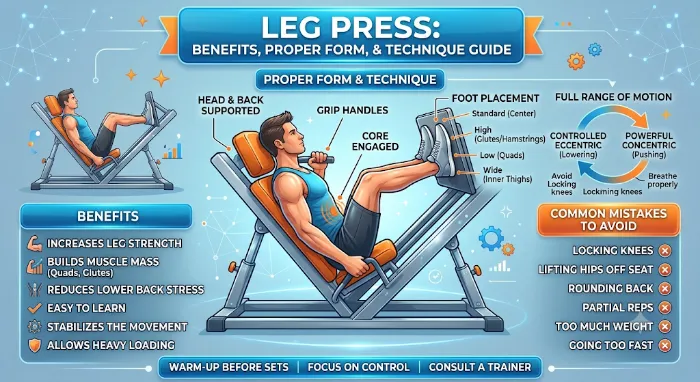
To do the leg press safely and efficiently, follow these steps:
- With your head, upper back, and hips pressed firmly on the pad, take a seat on the machine.
- Put your feet shoulder-width apart on the platform.
- If it seems comfortable and natural, keep your toes slightly turned out.
- Bracing your core, grab the handles.
- To unrack the sled, extend your legs enough.
- Keep your hips from rolling off the seat as you gradually lower the platform until your knees are firmly bent.
- Driving through your feet will push the platform back up.
- Avoid locking out your knees too forcefully.
- For controlled repetitions, repeat.
The repetitions that you can manage from beginning to end are the best. It is more beneficial to use a smooth method than to put more weight on the machine than you can manage.
Best Leg Press Foot Placement for Quad Focus:
As long as you can keep your heels down and your lower back constant, use a moderate stance with your feet shoulder-width apart and positioned in a central to slightly lower position on the platform if your primary objective is to target the quadriceps.
Quad-focused cues:
- Keep your feet shoulder-width apart.
- Put your feet in the middle or slightly lower.
- Allow your knees and toes to line up.
- With control, lower the sled
- Drive in the middle of the foot
While a more normal position is often preferable for general leg training, a higher foot position frequently places more attention on the glutes and hamstrings. The ideal setup allows you to exercise vigorously while maintaining a flat back and controlled movement.
Leg Press Sets and Reps:
The goal will guide the ideal set and rep plan.
For muscle growth
- 3 to 4 sets
- 8 to 15 reps
For strength-focused training
- 3 to 5 sets
- 5 to 8 reps
For beginners
- 2 to 3 sets
- 10 to 12 reps with moderate weight
Start with less than you believe you’ll need. Gradually increase the weight until your form is solid and consistent.
What are the benefits of leg presses?
Leg presses strengthen lower-body muscles :
One of the best exercises for isolating lower-body muscles is the leg press. Leg presses, for example, provide a significant exercise for the quadriceps.
The following muscles can be strengthened by using a leg press machine to push weight away from your body:
- Quadriceps (front of the thighs)
- Hamstrings (back of the thighs)
- Glutes (buttocks)
- Calves (back of the lower leg)
If you want to strengthen your lower body, the leg press machine might be quite beneficial.
Leg presses build muscle mass, power, and endurance :
Leg presses, like all resistance workouts, increase muscular growth by applying stress to the muscles. Your muscle cells are harmed by this good stress. Your muscle cells enlarge as your body heals the injury. Muscular hypertrophy is the term for this process of muscular growth.
Lower body muscular power may also be enhanced by leg presses. The capacity to apply force rapidly is known as muscle power. Leg presses can boost hip and leg muscle growth and strength, according to a professional bodybuilder and qualified personal trainer.
Additionally, having stronger leg and hip muscles may enable you to exercise with greater force and explosiveness.
Leg presses support strong bones :
To maintain healthy bones, experts advise weight training like leg presses. Your bones are under more stress whenever you apply a weighted force to your muscles.
The bones work harder because of the increased stress and pressure. In addition to preventing bone loss, this may help enhance bone mass and density. Stronger and less prone to breaking are denser bones.
As we age and begin to lose bone density, having strong bones becomes even more crucial. Exercise that strengthens your muscles is one of several tried-and-true methods to maintain the health of your bones.
Leg presses offer a beginner-friendly exercise:
The leg press is a fantastic exercise to include in your regimen if you’re new to resistance training. Unlike free weights like barbells or dumbbells, the machine has a defined range of motion. Additionally, it offers stability, so doing leg presses requires less balance and coordination.
This makes the leg press a safe and regulated exercise. You may increase the weight, pace, and repetitions after you master the technique.
Leg presses provide a versatile exercise :
Leg presses are not limited to novices. You may customize this adaptable strength-training workout to meet your fitness objectives. Leg presses are in three primary varieties:
- Horizontal: In this typical leg press, you press weight horizontally while sitting upright.
- Vertical: You press weight up and away from your body while lying on your back in a vertical leg press.
- Incline: During an incline leg press, you sit at a 45-degree tilt and push the weight away from your body.
Each offers a unique stimulation and permits an individual range of motion. You may switch from bilateral to unilateral if continuing, just like with many other lower body exercises. To alter the strain on the lower body, shift the posture of your feet.
For example, pointing your feet outward during a leg press may assist in strengthening the muscles in your inner calves. You may be able to develop muscles on the outside of your calves by pointing your foot inward.
Leg presses may help with injury recovery :
Leg presses may be suggested by physical therapists and other medical specialists to aid in the healing of knee or hip diseases. The weighted machine provides a joint-friendly, low-impact workout. Therefore, the chance of poor form and back pain is reduced. As you gain strength, you may progressively increase the resistance while isolating the leg muscles.
Because of the SAID principle (specific adaptation to imposed demands), leg presses may aid in the healing process following an injury. Your body will adjust to the pressures you put on it. Put another way, your joints and muscles may adapt to the particular resistance of leg presses and get stronger over time.
For example, it’s crucial to restore strength with specific exercises like leg presses if you need to strengthen your knee extensors (quadriceps) following an injury.
Leg presses were part of a maximum strength training regimen that improved recovery following a total knee replacement.
Leg presses boost athletic performance:
To enhance athletic performance for other compound exercises and movements, think about including leg presses in your training. Squatting, deadlifting, and running are a few examples.
It’s one of the best methods to increase your strength, power, and speed while preserving your lower back and other parts of your body that bear a lot of strain during exercise.
The exercise can also help with muscular imbalances because you can utilize one or both legs.
You may focus on and enhance strength and function on one side of your body by performing single-leg presses. For effective, strong movement in any activity or exercise, this is essential.
Who Should Try Leg Press Training?
Beginners: Without the coordination requirements of a barbell squat, the leg press machine’s guided range of motion makes learning lower-body mechanics simpler. Wall sits and air squats offer a similar low-barrier starting point at home. It’s not the particular instrument that matters, but the idea of starting small and growing gradually.
Women: A widely held belief is that women who engage in intensive lower-body exercise will appear to have larger legs. In actuality, leg exercise promotes long-term metabolic health and develops lean, defined muscle. Regular leg exercisers frequently report increased hip stability, better posture, and more energy throughout the day.
Mobility and independence as we age are directly supported by lower-body strength in older adults. The quad and glute strength required for confident stair climbing and fall prevention is maintained with the use of the leg press and its bodyweight substitutes. Before beginning any new workout regimen, please speak with your doctor if you already have joint issues.
Working Professionals: Long periods of sitting weaken the glutes and shorten the hip flexors, two issues that leg exercise immediately addresses. Without having to travel to the gym, a quick squat-focused practice two to three times a week might help address postural problems that develop during extended desk-based workdays.
Common Leg Press Mistakes to Avoid:
Lifting your hips off the pad:
On the leg press, this is one of the most common mistakes. Your lower back may round under pressure if your hips roll off the seat at the bottom. This often indicates that either the weight is too heavy, your range is too deep for you to move, or both.
Fix it by lowering the weight and stopping the descent at the lowest point you can manage while maintaining contact with the pad.
Locking out the knees too hard:
Some lifters jerk their knees into lockout while slamming the sled upward. This can put undue strain on the joints and reduce muscle tension.
Fix it by applying a lot of pressure while controlling the peak of each repetition.
Using too much weight:
The leg press is frequently viewed as an emotional lift. Many people perform short, clumsy repetitions with bad form after excessively loading the sled.
Fix it: Select a weight that allows you to go through a complete, regulated range of motion.
Letting the knees collapse inward:
In general, your knees and toes should line up. You lose quality and stability if they give in.
Fix it by concentrating on steady knee tracking and applying a reasonable weight.
Moving too fast:
Quick, uncontrolled repetitions make it more difficult to maintain technique and reduce muscular tension.
Fix it: Maintain control and slow down the descending phase.
Tips for effective use:
- Breathing technique: Inhale when you return to the beginning posture and exhale throughout the pushing phase.
- Stay away from movement: To efficiently engage the target muscles, use slow movements.
- Foot placement: You may target different muscle groups by changing the location of your feet; lower placement targets your quadriceps, while higher placement emphasizes your glutes.
- Consistency: For best results, include the workout in your program two to three times a week.
Safety considerations:
- Before utilizing the equipment, warm up with some dynamic stretching and mild cardio.
- Proper form: To avoid injuries, make sure you have the right posture and technique.
- Pay attention to your body: If you feel pain or discomfort, stop the workout.
- Speak with experts: If you’re not familiar with the equipment or workout, ask fitness professionals for advice.
FAQs:
What happens when you do leg press every day?
Daily leg presses cause extreme muscular fatigue, delayed muscle development, and an increased risk of overuse issues, including knee pain.
Does leg press increase thigh size?
Yes, the leg press makes your thighs bigger by strengthening your quadriceps and other lower body muscles.
How many times a week should you leg press?
Leg presses should be performed once or twice a week, with at least 48 hours of rest in between.
Is leg press better than squats?
The decision between the leg press and the squat relies on your fitness objectives, physical condition, and preference for machine-supported isolation or free-weight compound exercises.
Is leg press really necessary?
No, if you already perform squats or other complex lower-body workouts, the leg press is not necessarily required. Rather than being a necessary component, it is a helpful tool.
How long should I spend on leg press?
Depending on the number of sets and rest intervals, a typical leg press workout takes five to ten minutes in total.
Is 2 leg days enough to grow glutes?
Yes, you can develop your glutes with just two leg days a week. Since it strikes a balance between rapid muscular growth and enough recuperation time, most individuals believe that twice-weekly lower body exercise is the sweet spot.
Is a 70 kg leg press good?
If you’re a newbie, coming back from a break, or utilizing a pin-loaded machine, lifting 70 kg on a leg press is a good and acceptable place to start.
What happens if I leg press every day?
Leg presses put your quadriceps, hamstrings, and glutes under continual mechanical strain, which can result in extreme muscular fatigue, overtraining, and overuse problems rather than ongoing improvement.
References:
- Krishna. (2026, May 5). Leg press exercise Guide: Proper form, Muscles Worked, Benefits & Mistakes. LIFE FIT. https://lifefitindia.com/leg-press/?srsltid=AYCX9vJMcBiAJzH7zbsqrZOdCTOhTE5svAjgwsf0YwLX5aiEsr_WyEXD
- Bothra, T. (2026, September 19). What is a leg press? Benefits, form & home alternatives. Habuild. https://habuild.in/habitology/strength-and-fitness/what-is-a-leg-press
- ForPark. (2026, November 1). How to use the leg press | ASpace. ASpace. https://aspace.com.au/how-to-use-the-leg-press/