Exercises For Weak Knees in Older Adults
Introduction:
As you age, it’s typical for your joints to go through certain modifications. As a result, some people may develop arthritis, which can lead to painful symptoms, including pain and stiffness while moving. However, you may continue to do the things you enjoy since these natural changes won’t affect your daily activities if you keep your joints moving and strengthen the muscles that surround them.
One of the most important parts to strengthen is your knees, which you utilize for daily tasks including sitting, walking, and bending.
The significance of having healthy, powerful knees:
The biggest joints in your body are your knees. They’re responsible for supporting your body weight and providing stability while you stand, walk, or run. Your knees’ ability to absorb impact can be improved by strengthening the tissues around the knee joints, which can facilitate comfortable movement.
Additional advantages of the following are:
- Lowering knee pain or arthritis symptoms. You’ll have less joint pain when your knee tissues are stronger. Knee pain may be reduced by stronger muscles surrounding the knee, which can help absorb force so it doesn’t go through the joint.
- Improving balance. Since your knees support your body weight and provide stability while you move, having strong knees is essential for balance. Improved balance may also lower risks.
- Keeping up your standard of living. You can take part in worthwhile activities and hobbies when you can move without experiencing severe discomfort, which can promote your physical and emotional well-being as you age.
- Staying independent. Driving, walking, and doing household tasks all depend on having strong, healthy knees.
Benefits of physical activity for healthy knees:
A key aspect of joint health is an active lifestyle. Certain exercises may help maintain the health and strength of your knees while you try to strengthen them. They consist of:
- Walking on a daily basis helps you exercise your leg muscles without straining your knees too much.
- Swimming. Swimming promotes mild resistance to build muscle, which might reduce discomfort during exercise.
- Stationary cycling. When using a flat exercise bike, you cycle in front of you rather than under you while sitting in a reclined posture. Your knee joints could be better off in this posture.
Why knee exercises matter as you age:
Everyday mobility, such as walking across a room, ascending stairs, standing from a chair, and getting in and out of a car, depends heavily on your knees. Age-related changes in strength, balance, and mobility can make daily tasks seem more challenging.
That image may include knee pain, particularly if osteoarthritis is present. 32.5 million people in the United States suffer from osteoarthritis; knee osteoarthritis is most commonly seen in midlife and later adulthood, with the highest yearly incidence among those aged 55 to 64.
Your knees are involved in every step you take. With the right knee workouts, the muscles around the knee joint can be strengthened. The objective for elders is not to exert more effort. It involves controlling your movements, gradually increasing your strength, and selecting workouts that are appropriate for your body type, comfort level, and mobility requirements.
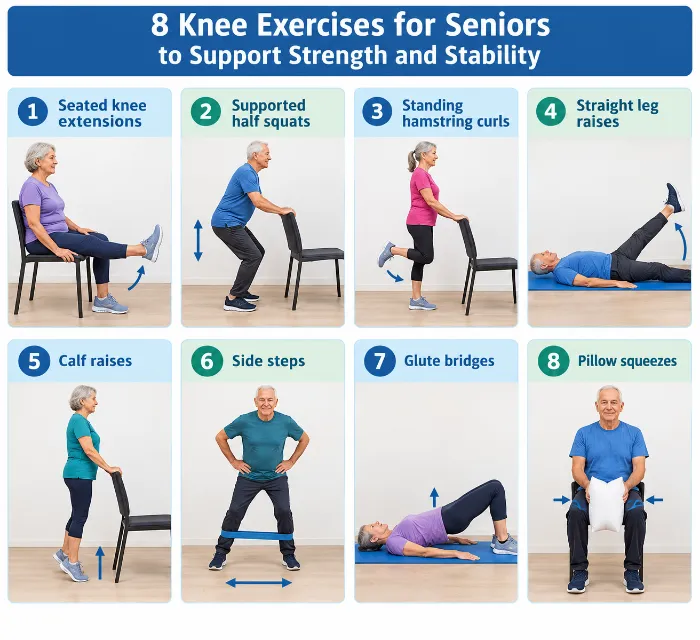
Eight knee exercises that are suitable for seniors to help improve strength and stability.
These senior knee workouts emphasize careful, slow movement. Many may be completed at home with support from a countertop, chair, or wall. As your strength increases, start with fewer reps and increase them gradually.
Seated knee extensions:
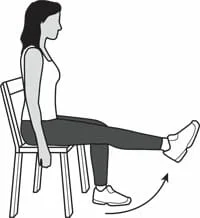
Why it is beneficial: Performing seated knee extensions helps to strengthen the quadriceps, which are the muscles located at the front of your thighs. These muscles facilitate walking, standing, and stair climbing.
How to do it:
- With both feet flat on the floor, take a high seat in a comfortable chair.
- Slowly raise one leg, so it is straight in front of you, making sure the leg remains straight.
- Hold for two to three seconds.
- With control, return your foot to the ground.
- On each leg, repeat ten times.
Senior modification: Lift your leg to a height that feels comfortable.To maintain balance, place one or both hands on the chair for support.
Avoid making the mistake of extending your leg or locking your knee forcefully at the peak of the exercise.
Supported half squats:
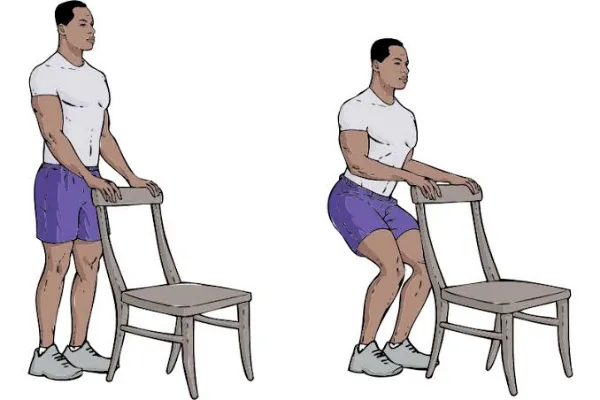
Why it’s beneficial: Supported half squats strengthen the glutes, hamstrings, and quadriceps.
To perform a proper half squat:
- Place your feet shoulder-width apart as you stand.
- Maintain a straight back and an elevated chest.
- As though you were falling into a chair, slowly lower your body ten inches.
- Throughout, make sure your knees remain behind your toes.
- To stand again, push through your heels.
- Aim for two or three sets of ten repetitions.
Senior modification: To assist with balance, use a chair or table. Instead of performing an unsupported squat, you might practice sitting down and getting up from a solid chair.
Avoid making the mistake of dropping too low or allowing your knees to fall inward. Verify that the positioning of your knees and toes is the same. You might get a useful practical guide from this video.
Standing hamstring curls:
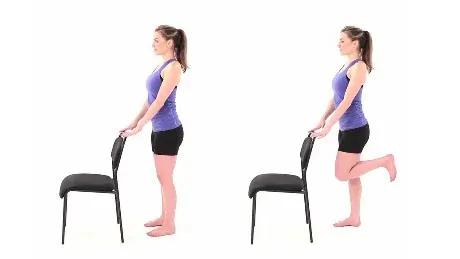
Why it is beneficial: Your thigh muscles are strengthened via standing hamstring curls. These muscles assist the knee when standing, bending, and walking.
Take these actions:
- If necessary, stand against a wall or use a sturdy chair for support.
- Keeping your hips horizontal, slowly bend one knee.
- Make an effort to bring your heels closer to your butt.
- Hold the position for 5 seconds, squeezing your hamstrings.
- With control, lower your legs to the beginning position.
- Perform 10 repetitions on each leg in two to three sets.
Senior modification: If you feel unstable, place both hands on a chair or countertop.
Avoid swinging your leg or arching your back. Continue to walk slowly and carefully.
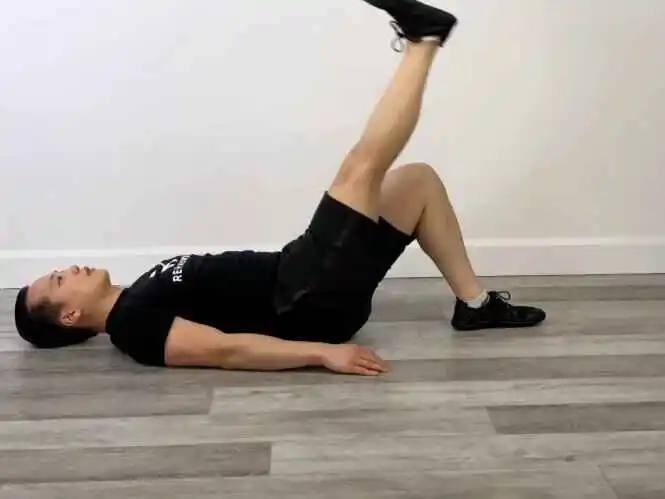
Straight leg raises:
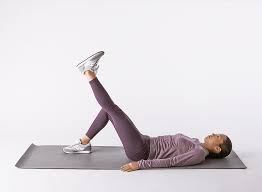
Why it’s beneficial: Straight leg raises keep the knee mostly still while strengthening the quadriceps. This can be a helpful knee-strengthening exercise for seniors wanting a regulated movement that doesn’t need standing.
Here’s how to carry things out properly:
- Lie on your back.
- With one leg bent and the other straight,
- Tighten your straight leg’s quadriceps.
- Raise your straight leg gradually.
- Hold for five seconds when the movement reaches its climax.
- With control, lower the leg.
- Do two or three sets of ten repetitions for each leg.
Senior modification: Request a sitting option from your doctor or physical therapist if lying on the floor is uncomfortable.
Avoid making the mistake of holding your breath or lifting your leg too rapidly. Slow movement is better.
Calf raises:
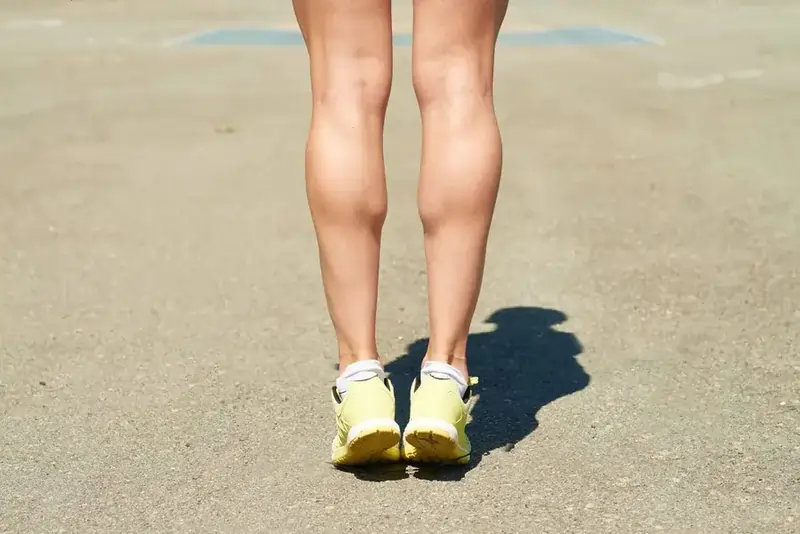
The lower leg muscles that enable walking, balance, and ankle control are strengthened by calf raises, which is why they are beneficial.
How to do it:
- Stand close to a wall or behind a strong chair.
- Maintain a hip-width distance between your feet.
- Elevate yourself slowly onto the balls of your feet.
- Hold for one to two seconds.
- Return your heels to the ground.
- Repeat ten to fifteen times.
Senior modification: Do this workout sitting if standing calf raises feel too tough.
Don’t jump. If you feel shaky, move gently and get assistance.
Side steps:
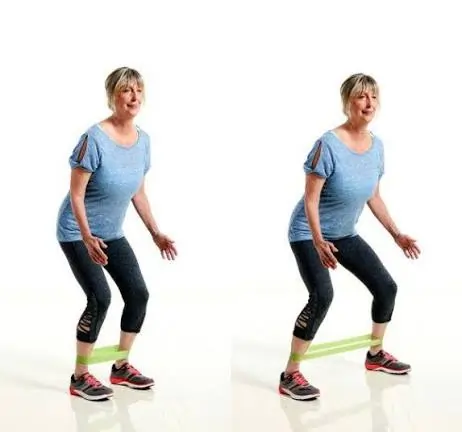
Why it’s beneficial: Side steps improve knee stability by strengthening the hips and outer thighs. Because your knees depend on the muscles above and below the joint for stability, this can be quite beneficial.
How to do it:
- Take a position facing a countertop or wall.
- Step out to the side with one foot.
- To meet it, bring the other foot in.
- Take 5-10 steps in one direction.
- Next, take a step in the opposite direction.
Senior modification: To maintain balance, take slower steps and place one or both hands on a counter.
Avoid turning your knees inward or your toes outward. Toes should remain pointed forward.
Glute bridges:
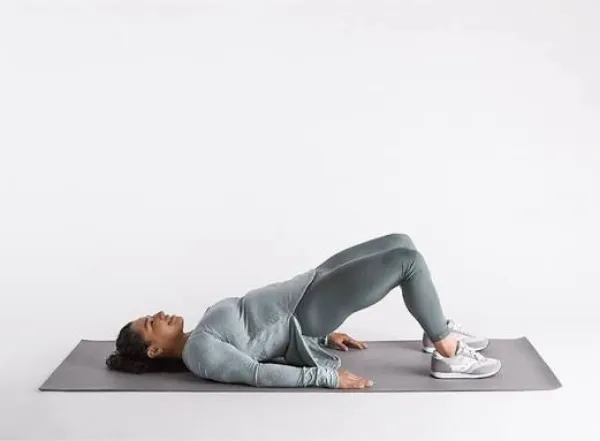
Why it’s beneficial: Glute bridges improve hip and glute strength. These muscles support your knees while you walk, stand, and climb stairs.
How to do it:
- Make sure your feet are hip-width apart.
- Slowly raise and lift your hips.
- Hold for two to three seconds.
- With control, return your hips to the floor.
- Repeat eight or ten times.
Elderly people should only be lifted to a suitable position. If your knees, hips, or back hurt, stop.
Avoid pushing through your lower back. Focus on squeezing your glutes and moving with control.
Pillow squeezes:
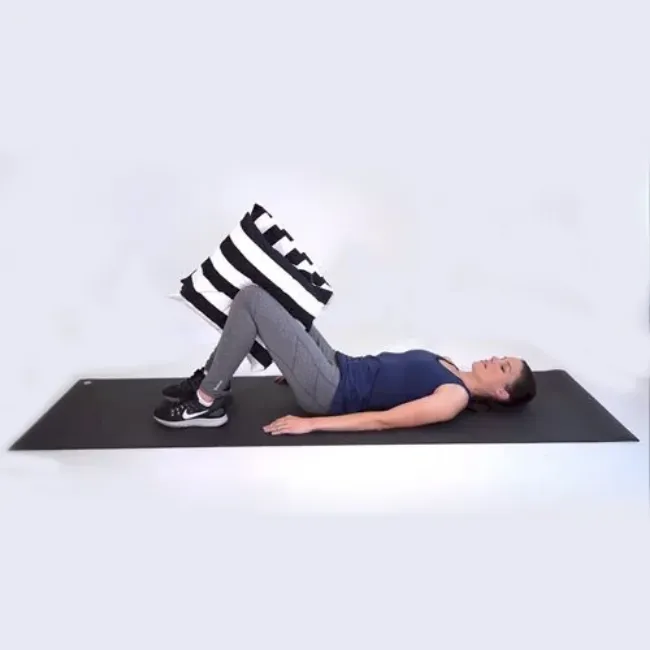
Why it’s beneficial: Pillow contractions strengthen the muscles of your inner thighs, which may help maintain knee posture and stability.
How to do it:
- Either lie on your back with your legs bent or take a seat.
- Place a pillow between your knees.
- Gently squeeze your knees.
- Hold for 3-5 seconds.
- Relax. Repeat 10 times.
Older modification: Apply light pressure. This should feel gentle and not painful.
Mistake to avoid: Don’t press so hard that it causes pain in your knee, hip, or groin.
Low-impact knee workouts that can support knee health:
Although strength training exercises are crucial, knee function can also be supported by low-impact aerobic activities. Walking, cycling, swimming, rowing, and other low-impact aerobic exercises have been demonstrated to improve physical function and even alleviate pain in people with moderate knee osteoarthritis, in addition to lower limb strength training.
Consider:
- Walking
- Bicycling or stationary cycling
- Swimming
- Water aerobics
- Rowing
Select knee-friendly activities, and if you’re unsure which options are best for you, see your doctor.
How Often Should Seniors Do Leg Exercises?
For many older adults, starting with gentle strengthening exercises two to four times a week is a great idea. On other days, walking, stretching, and light movement activities can also be included. The most effective exercise plan isn’t the one that sounds impressive. It’s the one that a person can actually stick with consistently.
Keeping up with an exercise routine is usually more important than how hard or intense it is.
Spending ten minutes a few times a week can be more helpful than one long, difficult session followed by several days of discomfort and inactivity. Gaining strength in later years is often not about big changes, but about restoring comfort and ease, one movement at a time.
Gentle Strength Builds Everyday Confidence:
Exercises for the legs and knees don’t have to be difficult to be beneficial. Simple actions like rising slowly from a chair, lifting your heels carefully, or gently straightening your knee while seated—these movements quietly support everyday activities. They help older adults maintain better balance, greater strength, and more comfort in their regular routines.
If you’re looking for leg-strengthening exercises for seniors, begin with mild and safe movements, and gradually increase as needed.
The aim isn’t to achieve perfection. The aim is to help maintain the ability to move around with more strength and less worry.
Lifestyle changes to support long-term knee health:
Knee exercises play a key role in maintaining long-term strength and mobility, but they are not the sole element influencing how well your knees function and feel.
While increasing lower limb muscular strength and flexibility is important for long-term knee health, other factors that affect knee function and total joint longevity—like body weight or suitable footwear—are often ignored.
Other habits that can aid in supporting knee health include:
- Wear shoes that are supportive and fit well.
- Do some warming up or stretching before starting any activity.
- Increase your strength slowly over time.
- If you must stand for a long period of time, take breaks.
- Use handrails on stairs when necessary.
- Pick activities that are easy on your knees if they feel uncomfortable.
- If your weight is creating problems with your knees, talk to your doctor about controlling it.
Small, consistent habits can help improve knee strength, stability, and mobility as time passes.
Precautions for older adults during knee exercises:
While exercise can be beneficial for reducing pain and improving knee strength, it is crucial to choose the correct types of exercises. If not, you may wind up doing more harm than good. Here are some important things to remember:
- Follow the advice given by your healthcare provider and physical therapist: They can recommend specific exercises that are safe and effective for your knee pain based on your condition.
- Pay attention to how your body feels during exercise and stop immediately if an activity increases your pain. Make sure to maintain proper form during all exercises, as incorrect technique can lead to more knee pain over time.
- Avoid movements that stretch your knees too far or place too much pressure on them, such as deep squats, lunges, and running, as these may not be suitable for your situation.
- Wear the right shoes: Make sure your workout shoes are in good condition. Over time, worn-out shoes lose their support, which can lead to more knee pain. On average, if you exercise for 30 minutes each day, you should replace your shoes every six months. However, if you are heavier, your shoes will wear out faster. You might want to rotate between two or more pairs of shoes to spread out the wear and extend their lifespan.
- Warm up before exercising: A warm-up helps increase your body temperature and improves blood flow, which helps loosen your muscles.
- It is also beneficial for your joints, as it prepares them for the physical activities you will perform.
- Change your routine: It is important to vary your workouts by trying different exercises and routines that target various muscle groups.
- This helps prevent overuse injuries and keeps your workouts effective and enjoyable.
Finally, it is important to begin exercising at a gentle pace and slowly increase the weight, time, or number of repetitions over time.
FAQs:
What are the common causes of weak knees?
Weak knees are usually due to weak or unbalanced muscles in the thighs, hips, and calves, which do not adequately support the knee joint.
What are some good physio exercises for strengthening weak knees?
Physiotherapy for knee strengthening involves using gentle exercises that focus on the quadriceps, hamstrings, and glutes to help support the knee joint and lessen pain.
How to strengthen leg muscles at home for seniors?
Older adults can safely build stronger leg muscles at home by doing gentle, practical exercises such as sitting up from a seated position, lifting their heels while standing, and raising their legs while sitting.
How long does it take to strengthen a weak knee?
It generally takes between 4 and 6 weeks of regular exercise to see noticeable improvements in mild knee weakness, and 8 to 12 weeks to fully recover from an injury or major deconditioning.
Is walking good for weak knees?
Yes, walking is typically beneficial for weak knees as it is a low-impact exercise that helps improve circulation and provides lubrication to the joints.
What is the number one mistake that makes knees worse?
The main error that aggravates knee pain and joint damage is not paying attention to the pain and not tackling its underlying cause promptly.
What are three good exercises for seniors?
Chair sit-to-stands, wall push-ups, and heel-to-toe standing balance are three important, low-impact exercises that are beneficial for seniors to improve strength and balance.
What is the best supplement for strengthening knee joints?
There isn’t one perfect supplement for improving knee joint health, but collagen peptides, curcumin, and glucosamine are widely recommended and supported by research for helping to maintain cartilage and ease joint pain.
References:
- Dpt, C. W. P., Mba, J. L. M., & Dpt, D. P. P. (2026, July 8). 5 Knee exercises for seniors to build strength and mobility. hingehealth. https://www.hingehealth.com/gb/en/resources/articles/seniors-knee-exercises/
- Dxd. (n.d.). 8 Knee Exercises for Seniors – Stronger Knee Health Exercises | Mutual of Omaha. https://www.mutualofomaha.com/advice/health-and-well-being/staying-fit/knee-exercises-for-seniors
- Adsavants.Seo. (2026, May 25). Gentle leg and knee exercises for senior strength. StoneBridge Senior Living. https://stonebridgeseniorliving.com/leg-strengthening-exercises-for-seniors/
- Hurley, M., Dickson, K., Hallett, R., Grant, R., Hauari, H., Walsh, N., Stansfield, C., & Oliver, S. (2018). Exercise interventions and patient beliefs for people with hip, knee or hip and knee osteoarthritis: a mixed methods review. Cochrane Database of Systematic Reviews, 4, CD010842. https://doi.org/10.1002/14651858.cd010842.pub2