Peroneal Tendon Strengthening Exercises
Introduction:
The inflammation of the peroneal tendons causes foot and leg pain in those with peroneal tendonitis. The foot and lower leg are stabilized by these tendons, which are situated outside the ankle. Overuse, trauma, or repeated stress on the region can result in peroneal tendonitis. In addition to edema, stiffness, and weakness in the injured limb, symptoms include pain and stiffness around the ankle.
An essential component of treating peroneal tendonitis is exercise. It can also help avoid additional injuries by strengthening the tendons and muscles around the ankle. Exercise can also speed up recovery by increasing blood flow to the affected region.
The lower leg’s outer compartment contains the peroneal muscles. The base of the fifth metatarsal is where the peroneus brevis enters after starting on the lower part of the fibula. The peroneus longus begins higher up on the fibula, sits over the top of the peroneus brevis, and rounds the bottom of the foot before attaching to the base of the first metatarsal and the plantar face of the medial cuneiform. The superior and inferior peroneal retinacula hold both tendons in place as they turn around the lateral malleolus, the bulge on the outside of your ankle. The peroneals function as plantar flexors and evertors when not bearing weight. The peroneus longus maintains the first ray in touch with the ground and stabilizes the foot’s transverse arch when walking.
A ruptured superior peroneal retinaculum may result in an acute subluxation of the peroneal tendon, where the tendon has slipped out of its groove behind the lateral malleolus. In sports like skiing, gymnastics, soccer, basketball, and football, the mechanism of injury frequently includes a contraction of the peroneals when the ankle is in a dorsiflexed and nonneutral posture while halting, landing, or during a cutting motion.
A high-force mechanism of damage may potentially result in a complete rupture of a peroneal tendon.
Let’s talk about the non-traumatic group now. Additionally, by “non-traumatic,” I mean injuries that are not acute and don’t need immediate medical treatment. For instance, a partial tear or persistent subluxation of the peroneal tendon may occur with little to no symptoms or loss of function.
What is peroneal tendonitis?
Inflammation of the tendons that are located along the side of your foot and the outer ankle bone is known as peroneal tendonitis. These strong bands of tissue connect the bones in your foot with the muscles in your lower leg. They protect your foot and ankle from harm by stabilizing and balancing them.
Overuse is typically the cause of this kind of foot tendonitis, although it can also occur unexpectedly if you fall or hurt your foot.
Who gets peroneal tendonitis?
Peroneal tendonitis may occur to anyone, but athletes who play activities requiring a lot of ankle movements are more likely to have it. Additionally, peroneal tendonitis is more likely to occur if you:
- Are Older Than Forty.
- Avoid Stretching Before Doing Physical Exercise.
- Have Specific Diseases Like Osteoarthritis, Diabetes, Rheumatoid Arthritis, Or Gout.
- Suffered Tendon Injuries In The Past.
- Your Feet Should Have High Arches.
- Are Obese Or Overweight.
- Contain Taut Tendons.
- Smoke.
How common is peroneal tendonitis?
Compared to other forms of foot tendonitis, such as Achilles tendonitis, peroneal tendonitis is less prevalent. Just 13 cases (less than 1%) of peroneal tendonitis were found in a study involving thousands of runners.
What causes peroneal tendonitis?
Repetitive use of the tendons can cause inflammation of the peroneal tendons over time. In contrast, an acute ankle injury such as a sprain may cause it to occur suddenly. The tendons’ ability to move smoothly may be affected by swelling of the tendons or the lubricated sheath surrounding them.
What are the symptoms of peroneal tendonitis?
Peroneal tendinitis symptoms can include:
- Ankle pain that extends along the length of your tendon.
- Pain that increases when you move.
- Your tendon may be swollen, red, or hot.
- Tendons that have thickened and have a lump or mass that travels with the tendon.
Can your peroneal tendon rupture?
Peroneal tendinitis can develop into a tendon rupture if treatment is not given. If your tendon tears, either entirely or partially, this can happen. Subluxation, which causes the tendons to dislocate, can also result from weak or damaged tendons. Subluxation or ruptures may result in:
- Ankle instability or weakness.
- Severe pain on the outside of your ankle and foot.
- Your tendons will feel sharp and fractured.
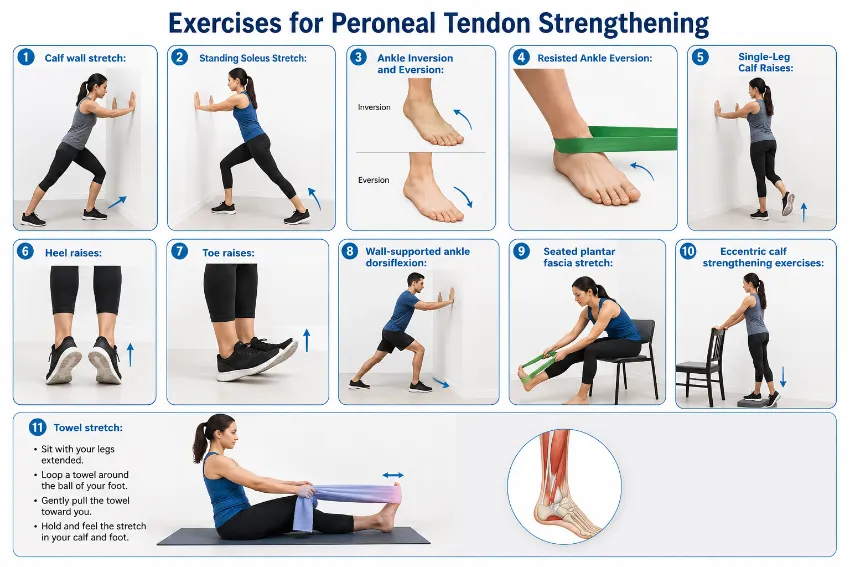
Exercises for peroneal tendon strengthening:
These are the following strengthening exercises for the peroneal tendon:
Calf wall stretch:
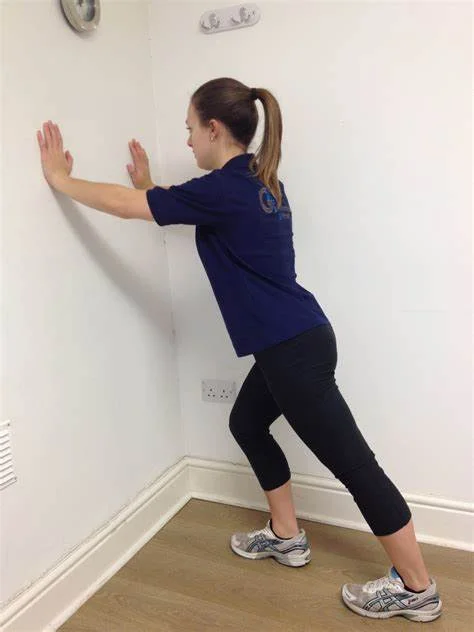
- With your hands facing the wall, place them there. With your injured leg, take a step back.
- Bend your front knee and move your weight forward while keeping both heels on the ground and your toes pointing forward. Maintain a straight back leg.
- Stretch for 15 to 30 seconds, or as long as you can.
- Do this three times.
Standing Soleus Stretch:
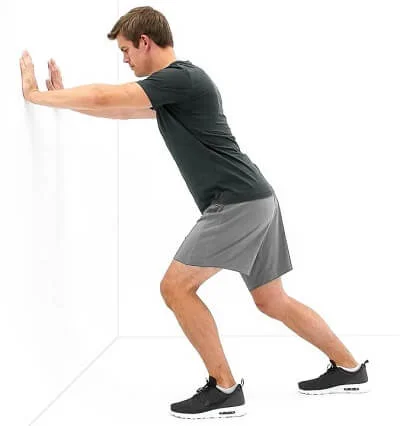
- Turn to face the wall and put your hands on it. With your injured leg, take a step back.
- Bend both knees and lean forward while keeping your heels on the ground and your toes pointed forward.
- Stretch for 15 to 30 seconds, or as long as you can.
- Do this three times.
Ankle Inversion and Eversion:
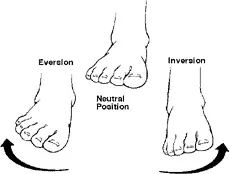
- Cross your injured leg over your other knee as you sit in a chair.
- Gently tilt the sole of your foot toward the floor while holding onto the bottom of it. Hold for five to ten seconds.
- Next, tilt your foot toward the ceiling by pulling it toward you. Hold for five to ten seconds.
- Repeat ten times.
Resisted Ankle Eversion:
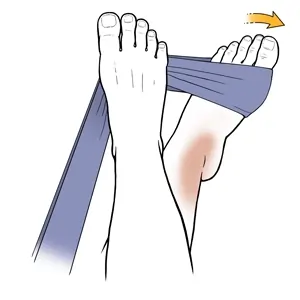
- Tie your injured foot in elastic tubing or a resistance band.
- Sit down on the floor with your legs straight. To fix the resistance band, grasp its end and press your unaffected foot against it.
- Pull against the band as you turn your injured foot outward. Return to the beginning after holding for five seconds.
- Repeat ten times.
Advice:
- Throughout the exercise, try to keep your knee still.
- Keep your knee from turning outward.
Single-Leg Calf Raises:
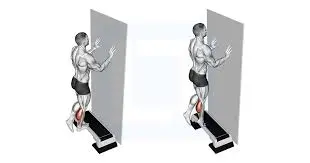
- For balance, place your hands on the back of a chair, table, or countertop while standing with your feet shoulder-width apart.
- Raise your unaffected foot off the ground so that your affected foot bears all of your weight.
- Raise your injured foot’s heel as high as you can, then bring it back down.
- Repeat ten times, then repeat.
Heel raises:
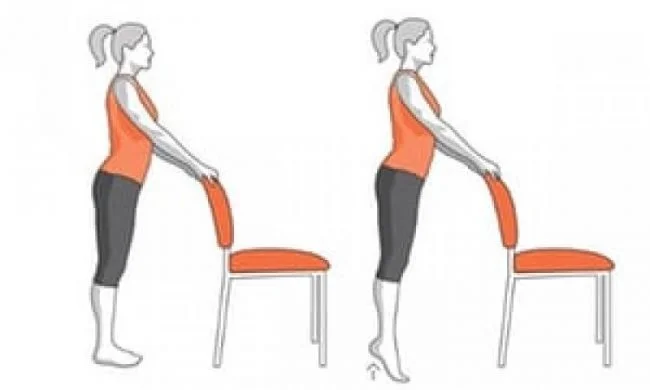
- The peroneal tendon can be strengthened and stretched by heel lifts, which can help prevent or treat peroneal tendonitis.
- To perform a heel raise, place your feet shoulder-width apart and balance by holding onto a firm object.
- Raise your heels gradually until you are standing on your toes, then return them to the beginning position.
- Repeat ten to fifteen times.
Toe raises:
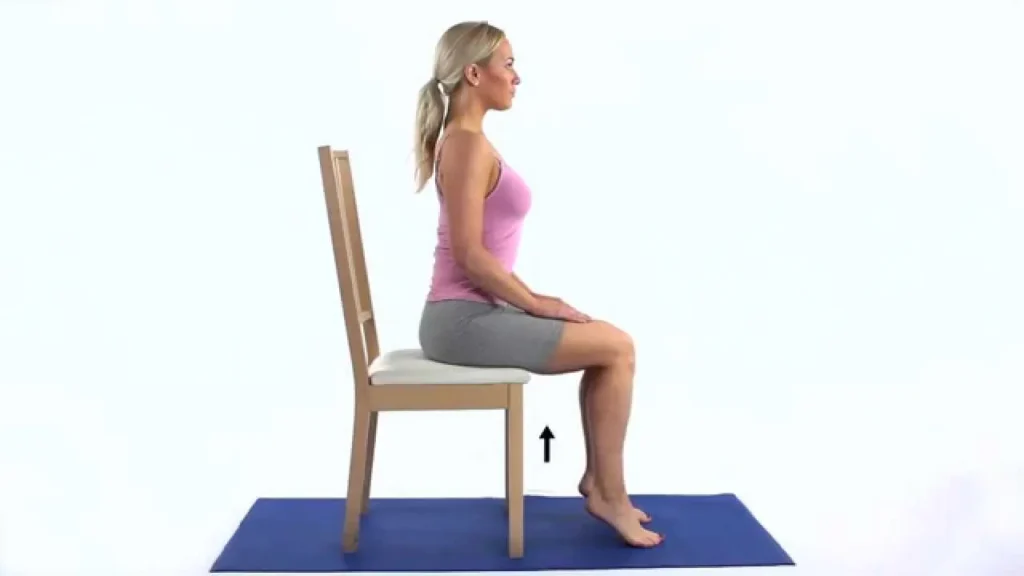
- Exercises like toe lifts can help relieve peroneal tendonitis symptoms.
- Step up onto your toes while standing with your feet hip-width apart to perform this exercise.
- After a few seconds of holding this position, lower yourself back down.
- Do this at least ten times.
Wall-supported ankle dorsiflexion:
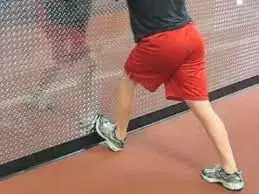
- Standing with your back against the wall, this exercise helps strengthen and stretch the tendons and muscles surrounding your ankle.
- Keep your feet away from the wall and your hips and back against it.
- Next, raise your toes.
- Maintain a straight knee and balance on both sides of your feet. Your ankle and leg should feel stretched.
- Return to the beginning after holding this posture for at least 15 seconds.
- Do the workout five times.
Seated plantar fascia stretch:
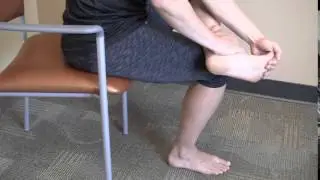
- By stretching the plantar fascia, this stretch relieves strain on the peroneal tendon.
- With your legs parallel to one another and your feet flat on the ground, take a seat in a chair.
- Grasp the ends of a rolled-up towel with both hands and place it under your right ankle.
- Keep your leg straight, and gently push on the towel until your calf muscles and arch feel stretched.
- Repeat with the left leg after holding for 15 to 30 seconds.
Eccentric calf strengthening exercises:
- In order to reduce tendon pain, these workouts concentrate on the downward part of a calf raise.
- Place your feet hip-width apart and stand on a raised surface to begin.
- Raise your right heel till you are standing on your toes while maintaining a straight left leg.
- Before going back to the beginning position, lower your right heel below the level of the elevated surface and keep it there for two seconds.
- After ten repetitions, switch legs and repeat with the left leg.
Towel stretch:
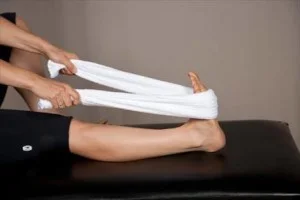
A bath or pool towel is needed to complete this stretch.
- With your feet out in front of you, sit on the ground.
- Using the towel, wrap it around one foot’s toes.
- Stretch from the bottom of the foot to the back of the lower leg by gently pulling back.
- For 30 to 60 seconds, hold this stretch.
- Repeat with the opposite leg.
- This exercise should be performed two or three times on each side.
Tips for Effective Exercise:
Take these preventative measures to protect your ankles from the pain and the consequences of peroneal tendonitis:
- Start slowly: As you get better at each exercise, start with a few repetitions and progressively increase the number.
- Warm up: Spend a few minutes walking or jogging to warm up before beginning your workouts.
- Pay attention to your body and only take on as much as you believe your body can handle. Seek medical help as soon as you feel sharp or unusual pain.
- Complement with non-impact cardio: To increase general fitness, add low-impact cardio exercises like cycling or swimming to your regimen.
- Frequent health examinations: Through routine appointments, keep an eye on your development and discuss any issues with your healthcare physician.
- Maintain records: Keep track of the number of repetitions, sets, and pain you feel during your workouts.
- Before beginning an exercise regimen, speak with your doctor: Before starting a new workout program, it’s crucial to speak with your healthcare physician if you have any underlying medical issues.
Other Treatment Options to Relieve Pain:
Management or conservative techniques such as RICE, painkillers, and physical therapy can be used to treat peroneal tendonitis.
RICE:
One popular acronym for a self-care strategy is RICE:
- Rest: Stay away from activities that cause the injury and give it time to heal.
- Ice: For 15 to 20 minutes, apply an ice pack to the painful area to reduce pain and inflammation.
- Compression: Use an elastic bandage to provide support for the injured ankle.
- Elevation: To help reduce swelling, keep the injured foot raised above the chest.
Over-the-counter Medications:
Pain and inflammation can be reduced by over-the-counter anti-inflammatory drugs or painkillers. Before beginning any new medicine, speak with a healthcare professional.
Physical Therapy:
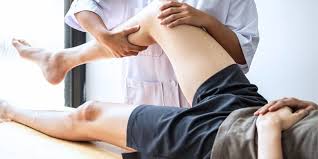
Another useful strategy for managing or treating peroneal tendonitis is physiotherapy for ankle pain. A physical therapist can create an exercise regimen that is specifically designed to meet your needs. This involves stretches to increase ankle stability and strengthen the peroneal tendons. To reduce pain and inflammation, they might also use techniques like electrical stimulation or ultrasound that are used in ankle injury physiotherapy.
Additionally, massage therapy can help improve blood flow, relieve muscle tightness, and support healing. To treat the injury site, physiotherapists may use methods like myofascial release or deep tissue massage.
Benefits of exercises for peroneal tendonitis:
Stretching the tendon can assist in increasing its flexibility and range of motion. Stretching may therefore aid in the recovery of any lost range of motion following an accident.
Exercises that target the peroneal muscles may help strengthen and enhance the area following the resting phase of recovery. Stretches and exercises that target the ankle and calf muscles may help to stabilize the region and lower the chance of further damage.
The peroneal muscles attach to the bottom of the foot on the outer edge of the fifth metatarsal, run along the side of the shin parallel to the fibula bone, and wrap around the outside of the ankle. Many various places become at risk of pain and instability as a result. The lower body may remain healthy and strong with a well-rounded, regular workout regimen.
- Reduced pain and swelling around the ankle
- Enhanced power and endurance for everyday activities or sports
- Faster recovery as a result of improved circulation
- Enhanced flexibility and range of motion in the ankle and foot
- Improve your general health and quality of life.
- Prevent ankle injuries and instability.
- An excellent addition to a calf stretching regimen
How to prevent peroneal tendonitis:
Peroneal tendinitis can be avoided with a few preventative measures. Among them are
- Stretching the calf, ankle, and peroneal muscles regularly
- Wearing footwear that supports the foot properly
- Keeping good form when performing exercises involving the calf, ankle, or peroneal muscles
- Gradually increasing the intensity of any weight-bearing activities, such as jogging, walking, or running
Precautions for Peroneal Tendon Strengthening Exercises:
Ankle strength and stability can be improved by peroneal tendon strengthening exercises, but these should be done gradually and without aggravating symptoms.
- Start up slowly: As your strength increases, gradually increase the resistance or repetitions.
- Exercise should not be done while experiencing sharp pain. While mild muscular fatigue may be tolerable, if you have severe, increasing, or chronic pain in the area of your outer ankle, stop.
- First, warm up. Before strengthening activities, move your ankles gently or engage in light exercise for five to ten minutes.
- Maintain correct ankle position: When performing resistance activities, try not to roll your ankle excessively inward or outward.
- Use the right amount of resistance: Resistance bands should offer a doable task without creating pain or the need for balancing movements.
- Stay away from sudden training increases: Don’t quickly raise the intensity, duration, frequency, or resistance of your workouts.
- Be careful after an ankle injury: Before strengthening, get a professional evaluation if you have a recent ankle sprain, substantial swelling, bruises, or trouble bearing weight.
- Keep an eye on swelling: After exercise, increased swelling, pain, or tenderness could be a sign that the load is too great.
- Carefully advance to weight-bearing exercises: Exercises for standing and balance should only be added after basic movements are comfortable.
- Wear supporting footwear: When performing weight-bearing strengthening activities, wear comfortable, stable shoes.
- Never ignore instability: A physiotherapist or physician should be contacted if you have frequent ankle giving-way, clicking or cracking, or a sensation of tendon displacement.
- Give the tendon enough time to recover between severe strengthening exercises.
FAQs:
What are some eccentric exercises for strengthening the peroneal muscles?
In order to restore tendon resistance and ankle stability, eccentric peroneal strengthening entails extending the peroneal muscles under a regulated load.
How do I strengthen my peroneal muscles?
Balance exercises and specific resistance band movements can help you build stronger peroneal muscles.
What are the symptoms of peroneal muscle pain?
On the outside of the lower leg and foot, peroneal muscle or tendon pain results in pain, edema, or weakness. Ankle sprains, poor foot mechanics, and overuse are common causes. Rest, ice, and supportive bracing are examples of relief techniques.
Does walking help peroneal tendonitis?
If you have mild peroneal tendonitis and walk on level surfaces, walking can be safe and beneficial. However, if your ankle is in the acute phase, walking can aggravate the condition.
How to loosen peroneal muscles?
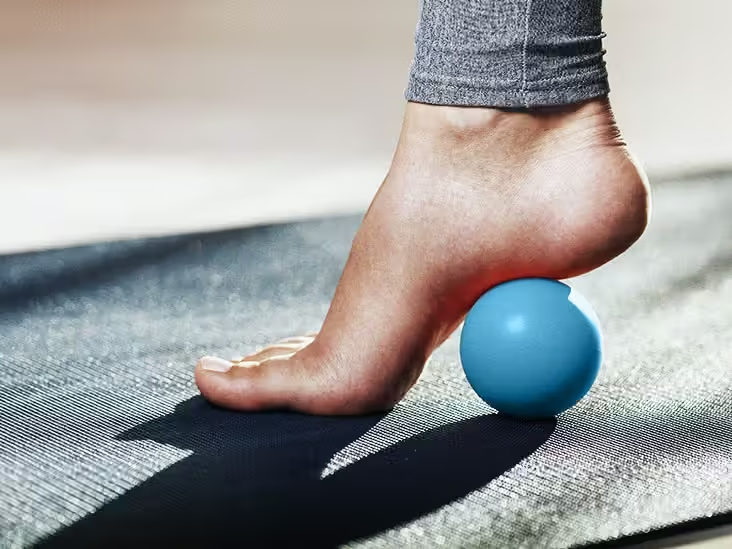
Targeted myofascial release, mild stretches, and ankle mobility exercises can help relax tense peroneal muscles on the outside of your lower leg.
What are the symptoms of peroneal tendon stiffness?
Pain, swelling, and tenderness on the outside of the ankle and foot are caused by a strained or tight peroneal tendon. Peroneal tendonitis is pain caused by weak lower leg muscles, ankle sprains, or overuse.
What are some good physiotherapy exercises for peroneal tendonitis?
Strengthening the outer lower leg muscles, enhancing ankle stability, and relieving stress through mild stretching are the main goals of effective physical therapy exercises for peroneal tendonitis.
How long do peroneal tendon strains take to heal?
Conservative treatment for peroneal tendon strains and inflammation usually takes 2 to 12 weeks to heal, while recovery is mostly dependent on the severity of the injury.
References:
- Rees, J. D., Stride, M., & Scott, A. (2013). Tendons—time to revisit inflammation. British Journal of Sports Medicine, 48(21), 1553–1557.
- Abate, M., Gravare-Silbernagel, K., Siljeholm, C., Di Iorio, A., De Amicis, D., Salini, V., Werner, S., & Paganelli, R. (2009). Pathogenesis of tendinopathies: inflammation or degeneration? Arthritis Research & Therapy, 11(3), 235.
- Hsu, Y., Wu, W., Chang, K., Han, D., & Chou, L. (2017). Healing of Achilles tendon partial tear following focused shockwave: a case report and literature review. Journal of Pain Research, Volume 10, 1201–1206.
- Sinha, P., Kim, A., Umans, H., & Freeman, L. M. (2000). Scintigraphic findings in peroneal tendonitis. Clinical Nuclear Medicine, 25(1), 17.
- Park, H. J., Cha, S. D., Kim, H. S., Chung, S. T., Park, N. H., Yoo, J. H., Park, J. H., Kim, J. H., Lee, T. W., Lee, C. H., & Oh, S. M. (2010). Reliability of MRI Findings of Peroneal Tendinopathy in Patients with Lateral Chronic Ankle Instability. Clinics in Orthopedic Surgery, 2(4), 237.