Balance Exercises for People Over 60: Improve Stability & Prevent Falls
Introduction:
You may enhance your mobility and health at home by performing these easy balancing exercises. If you haven’t worked out in a long time, don’t worry; these balancing exercises are simple and mild. Stay hydrated and wear loose, comfortable clothing.
Gradually increase the number of repetitions of each exercise over time by building up gradually. Just in case you lose your balance, try performing the exercises close to a wall or a stable chair.
10 Benefits of Balance Training for Seniors:
Enhancing balance in older persons affects almost all areas of their physical and mental health, not simply reducing falls. What regular practice may progressively support is as follows:
Reduces the Risk of Falling:
Among persons over 60, falls were among the top causes of injury. By strengthening the stabilizing muscles in your hips, ankles, and core, balance training helps your body respond more quickly when you lose your balance.
Improves Posture:
Over time, many elderly people develop a forward-leaning posture. The deep postural muscles that keep the spine straight are activated by balance exercises, which improves the comfort of daily standing and walking. You may enhance your balancing practice by looking into yoga for better posture.
Strengthens the Lower Body:
Exercises that also strengthen the quadriceps, glutes, and calf muscles that directly support continuous movement include single-leg stands and side leg lifts.
Supports Joint Health:
Over time, controlled balancing exercises assist in maintaining joint health and lessen knee and hip stiffness by gradually loading the joints through a functional range of motion.
Enhances Coordination:
Your nervous system is challenged by balance training to more effectively coordinate movement signals. Reaction time and body awareness tend to gradually improve with regular exercise.
Builds Bone Density:
Weight-bearing balancing exercises stimulate bone-strengthening reactions by gently stressing the bones, which is especially important for seniors controlling their risk of osteoporosis. See how, as part of a more complete routine, strength exercise promotes bone density.
Improve Confidence in Daily Movement:
After a near-fall, many elderly people become wary. Regular practice of balance restores physical confidence, making tasks like walking on uneven ground or ascending stairs possible once again.
Supports Mental Sharpness:
Exercises for balance require focus and spatial awareness, providing a mental and physical workout. Physical coordination exercises may improve mental abilities in older persons, according to several studies.
Reduces Muscle Stiffness:
Dynamic balancing exercises help you move more easily throughout the day by stretching and activating muscles that contract with age, especially those around the hips, ankles, and knees.
Promotes Consistency in Fitness:
Exercises for balance are easy enough to perform every day, don’t require any equipment, and only take 15 to 20 minutes. They are among the most enduring exercise routines that seniors may develop because of this low barrier.
How to find your balance and get started:
Starting at a comfortable level and making tiny, incremental improvements is the key to getting started and moving forward safely and successfully.
Here are some tips to get you started:
- Find out which of your legs is dominant. To increase skill, begin each exercise with your nondominant side.
- While you’re in the position, keep your form correct.
- To keep your balance, look directly ahead at a fixed place.
- Try putting your feet a little bit farther apart if you struggle with balance when standing.
- Slightly bend your knees. This increases your stability and stops your knees from hyperextending.
- Evenly balance your weight between the two feet. Observe whether your weight changes forward or backward, or whether you prefer to place more weight on one foot.
- You can try changing arm positions, looking up at the ceiling, or closing one eye at a time as your balance gets better.
- Change the number of sets, repetitions, or range of motion in the positions to suit your needs.
While performing these exercises, shoes might assist in developing the muscles that support your feet; wearing shoes may offer more stability and grip.
To provide comfort and lessen the risk of slipping, use a yoga mat. Look for someone who can manage and assist you, if at all possible.
Balance exercises:
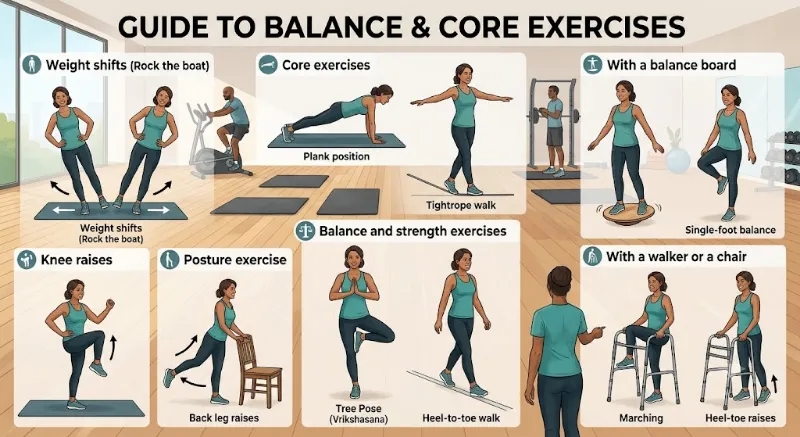
Weight shifts:
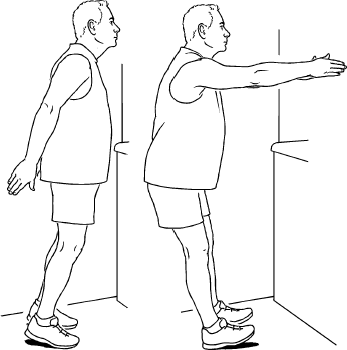
Muscles worked: quads, calves
- Place your feet hip-width apart as you stand.
- Transfer your weight to your right foot.
- Lift your left foot. To develop the movement,
- For up to 30 seconds, maintain this posture.
- Next, work on the other side.
- Do each side three times, though if you’re just starting, less is OK.
Rock the boat:
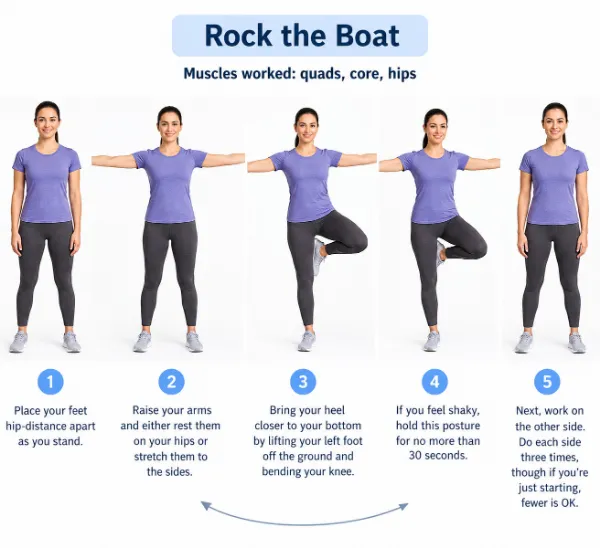
Muscles worked: quads, core, hips
- Place your feet hip-distance apart as you stand.
- Raise your arms and either rest them on your hips or stretch them to the sides.
- Bring your heel closer to your bottom by lifting your left foot off the ground and bending your knee.
- If you feel shaky, hold this posture for no more than 30 seconds.
- Next, work on the other side.
- Do each side three times, though if you’re just starting, fewer is OK.
Core exercises:
Tightrope walk:
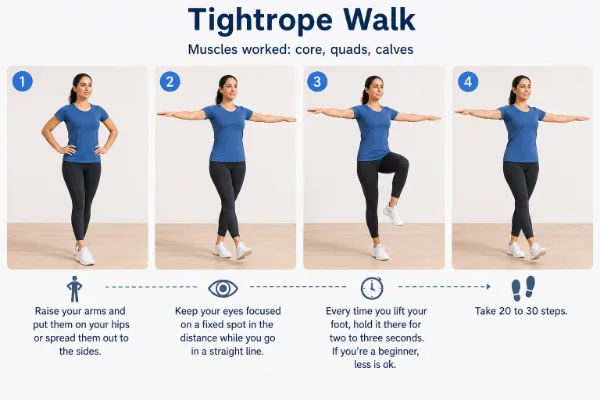
Muscles worked: core, quads, calves
- Raise your arms and put them on your hips or spread them out to the sides.
- Keep your eyes focused on a fixed spot in the distance while you go in a straight line.
- Every time you lift your foot, hold it there for two to three seconds. If you’re a beginner, less is ok.
- Take 20 to 30 steps.
Knee raises:
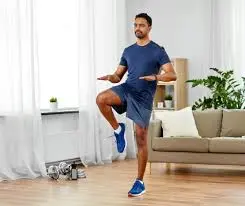
Muscles worked: core, calves, hips
- Transfer your weight to your right foot.
- To get your upper leg parallel to the floor, raise your left knee.
- For ten to fifteen seconds, maintain this posture.
- Reach your hands toward your outstretched foot to increase the challenge.
- Stretch out your legs and go back to the beginning posture.
- Do this three times. Next, work on the other side.
Posture exercise:
Back leg raises:
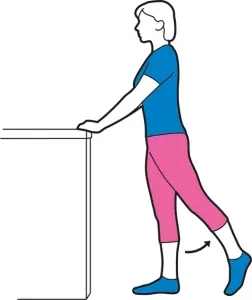
Muscles worked: lower back, glutes
- Put your hands on a chair’s back or a wall. Although it’s advised to begin using a stable surface, you could eventually be able to perform this exercise without one.
- Transfer your weight to your right foot.
- Raise your left leg as high as you can while doing so slowly.
- For five seconds, maintain this posture.
- Go back to where you were.
- Perform two to three sets of ten reps.
- Next, work on the other side.
Balance and strength exercises:
Tree Pose:
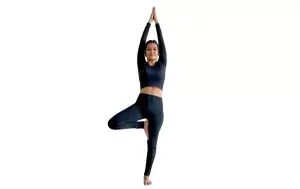
Muscles worked: hips, calves, quads
- Transfer your weight to your right foot when standing.
- Place the sole of your left foot on your thigh, shin, or ankle, or position it to the side with your heel up. Don’t put it on your knee.
- Put your hands in whatever posture seems comfortable.
- Hold for a maximum of one minute.
- Next, work on the other side.
Heel-to-toe walk:
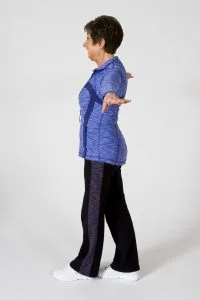
Muscles worked: calves, quads
- Press your heels on a wall while you stand.
- Put your left foot ahead of your right.
- Reach your right toes to your left heel.
- Next, position your right foot ahead of your left foot.
- Make contact between your left toes and your right heel.
- Take 20 more steps.
With a balance board:
Single-foot balance:
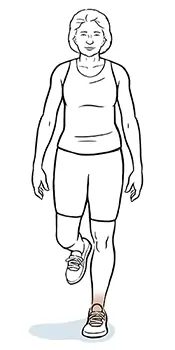
Muscles worked: calves, hips
Using a balancing board, this exercise is comparable to knee lifts.
- Put the center of the board under your right foot.
- Elevate your knee as high as you can while raising your left foot.
- For up to 30 seconds, maintain this posture.
- Next, work on the other side.
- Repeat each side two or three times, or as many times as you can.
With a walker or a chair:
Marching:
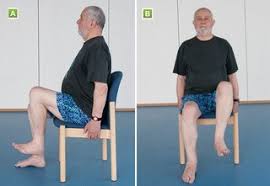
Muscles worked: hips, lower back, quads
- Hold your walker in both hands as you stand.
- As much as you can, raise your left knee.
- Lift your right knee after lowering it.
- For a total of 20 repetitions, switch sides.
This exercise can also be performed while sitting.
Heel-toe raises:
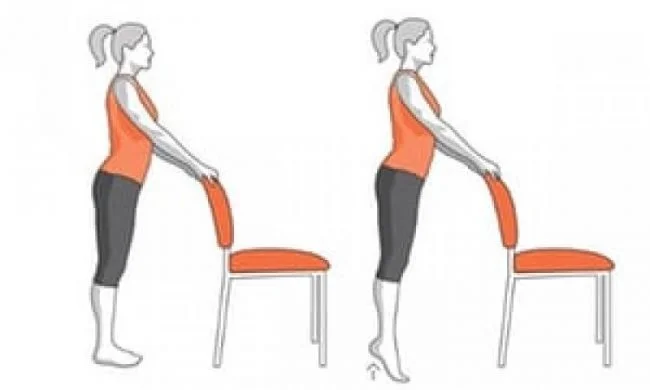
Muscles worked: calves
- Place both hands on a chair or your walker as you stand.
- For three seconds, raise both heels and maintain your balance on the balls of your feet.
- Next, elevate your toes and transfer the weight to your heels.
- Perform two to three sets of ten to twenty reps.
Precautions for Balance Exercises in People Over 60:
- Use support: For help, do exercises next to a strong chair, countertop, or grab bar.
- Clear the space by getting rid of cords, carpets, debris, and other trip hazards.
- Use appropriate footwear: Stay away from barefoot exercise on slick surfaces and use well-fitting, non-slip shoes.
- Go gently at first: Start with basic balancing exercises and work your way up.
- Stay away from abrupt movements: Move gently and deliberately.
- Maintain a steady posture: Stay straight and avoid twisting or leaning too much.
- When necessary, have supervision: Exercise with a support person or physiotherapist is recommended for people with severe balance issues or a fall history.
- Avoid exercise while feeling fatigued or ill: If you experience nausea, severe shortness of breath, chest pain, dizziness, or unusual weakness, stop.
- Make use of the appropriate degree of difficulty: If you have weak balance, avoid starting with unsupported single-leg standing.
- Take rest periods: Being tired might make it more likely that you’ll lose your balance and fall.
- Think about health issues: Individualized exercise recommendations may be necessary for those with neurological illnesses, cardiac conditions, arthritis, or visual issues.
- Make slow progress: Only when the individual can safely complete the present exercise may hand help be reduced, or the level of difficulty increased.
- When working out by yourself, keep a phone or emergency contact close at hand.
Important: A medical expert or physiotherapist should evaluate balance training on an individual basis for older persons who have experienced a recent fall, frequent falls, severe dizziness, or significant mobility/balance problems.
FAQs:
How can I improve my balance after 60?
Simple stability exercises must be practiced every day to improve balance over 60. Heel-to-toe walking, weight transfers, and single-leg standing are all beneficial workouts. For safety, always do exercises next to a kitchen counter or a sturdy chair. Continue to practice for five to ten minutes every day.
What are 5 exercises for balance for seniors?
Single-leg balancing, heel-to-toe walk, side leg lift, sit-to-stand, and marching in place are five easy, senior-safe exercises that increase stability and avoid falls. For safety, always do things close to a kitchen counter or a strong chair.
Can balance be improved with age?
You can, in fact, improve your balance at any age. Balance relies on your core strength, lower body, inner ear, and vision working together. Practicing targeted stability movements helps retrain your brain and muscles to keep you stable.
How do seniors improve balance?
Seniors should perform regular lower-body strengthening and stability exercises while standing close to a solid chair or kitchen counter for support in order to safely enhance their balance. To strengthen your legs and core, try doing side steps, heel-to-toe walking, and single-leg stands for five to ten minutes each day.
What vitamin is good for balance?
The most crucial vitamins for balance and stability in the body are B12 and D. While vitamin D strengthens your bones and muscles to keep you stable, vitamin B12 maintains your nerves so your brain can communicate with your muscles. Dizziness, weakness, and an increased risk of falls can result from a deficiency in either vitamin.
What is the best treatment for balance problems?
The underlying cause of balance issues indicates the best plan of action. Simple in-office head moves for inner ear crystals can be used, as can specialized physical therapy, dietary changes, or the treatment of underlying medical issues.
How long should a 70-year-old be able to balance on one foot?
The best time for a 70-year-old to balance on one foot is between 15 and 26 seconds. For health and safety, being able to stand on one leg for ten seconds is seen as a crucial baseline, and being able to do so for thirty seconds shows excellent balance.
References:
- Diracoglu, D., Aydin, R., Baskent, A., & Celik, A. (2005). Effects of kinesthesia and balance exercises in knee osteoarthritis. JCR Journal of Clinical Rheumatology, 11(6), 303–310.
- Allet, L., Armand, S., De Bie, R. A., Golay, A., Monnin, D., Aminian, K., Staal, J. B., & De Bruin, E. D. (2009). The gait and balance of patients with diabetes can be improved: a randomised controlled trial. Diabetologia, 53(3), 458–466.
- Nelson, M. E., Rejeski, W. J., Blair, S. N., Duncan, P. W., Judge, J. O., King, A. C., Macera, C. A., & Castaneda-Sceppa, C. (2007). Physical activity and public health in older adults. Circulation, 116(9), 1094–1105.