Top 11 Exercises for Total Body Strength and Conditioning
Introduction:
Top Exercises for Total Body Strength and Conditioning focus on building muscle, improving endurance, boosting mobility, and enhancing overall fitness—all in one balanced routine.
In the context of fitness, the pursuit of strength and conditioning is akin to producing an artistic creation. Just as an artist blends colors to create a beautiful painting, so too should a well-rounded fitness program incorporate a variety of activities to build a robust, resilient body. Full-body strength and conditioning exercises improve general health and wellness in addition to sports ability.
Before starting any specific exercises, it’s critical to understand the benefits of full-body training. Because it works multiple muscle groups in a single session, it promotes efficiency, making it ideal for persons with limited time. Full-body workouts also boost functional strength, which enhances performance in everyday chores and sports. They can also speed up metabolism, help regulate weight, and improve cardiovascular health. Let’s look at some of the best full-body workouts that are both effective and well-rounded.
Exercises for Total Body Strength and Conditioning Video:
Exercises for Total Body Strength and Conditioning:
Squats:
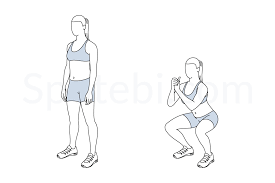
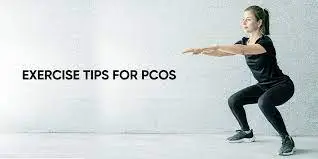
Many fitness professionals have referred to squats as the “king of exercises,” and with good cause. When done correctly, they are an excellent full-body workout that calls for a solid balance of mobility, stability, and functional strength. For a minimum level of fitness, functionality, and quality of life, everyone should be able to perform a deep, controlled, and attractive squat.
This is a very “metabolic” exercise, which means it will work a lot of your muscles. Particularly if you add more weight, this is a full-body exercise rather than just a leg workout. The main muscles that squats will work are your quadriceps, glutes, hamstrings, and lower back.
Push-Ups:
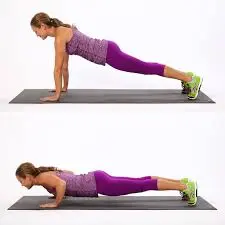
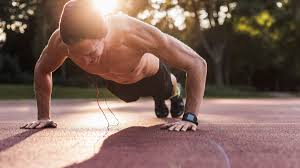
Anything that entails a pushing motion is considered a push-up exercise. Push-Ups can be further divided into vertical pushing (e.g., pressing something above your head) and horizontal pushing (e.g., push-ups). The chest, shoulders, and triceps will all be used in some capacity during any pushing activity. These muscles will be activated and used in somewhat different ways depending on the push’s angle.
If anything, push-up exercises are the most popular ones seen in most training regimens. However, they can lead to shoulder troubles, postural problems, and muscular imbalances if they are not counterbalanced with “pulling” exercises. Therefore, while pushing exercises are vital, don’t overdo them at the expense of the other workouts.
Deadlifts:
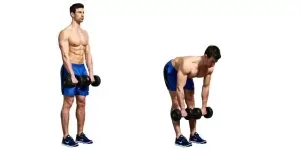
One of the greatest exercises for the entire body, a deadlift will work more muscles than any other single activity. Picking up something heavy off the ground is the fundamental idea behind a deadlift. Although it’s arguably the best workout you can do for your strength, functionality, and fat loss, it also has many useful applications in daily life.
An essential component of this exercise is mastering the correct technique for bending or “hinging” at the waist without flexing your spine. Because of its nature, it is crucial to take the time to acquire the right technique and start light.
In terms of form and technique, deadlifts are arguably the most frequently abused exercise; thus, remember that poor form can have detrimental effects on your health.
If you’re not sure how to accomplish these correctly, get help from a qualified trainer. Deadlifts are an excellent postural exercise because they primarily work your hamstrings, glutes, and entire back musculature. It will help you “straighten” up by strengthening almost all of your back muscles.
Plank:
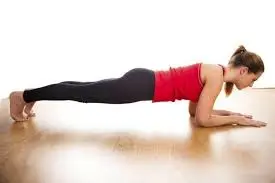
Start by placing your forearms parallel to one another on the floor in the forearm plank position. You should have a straight spine that runs parallel to the ground. As you push through your toes, brace your core. Maintain a straight body alignment while holding this position for 10 to 60 seconds. You can alter this workout by putting your knees on the floor.
Lunges:
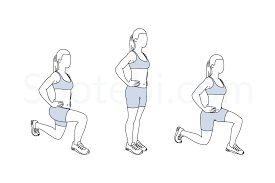
Another fantastic workout that has many of the same advantages as squats is the lunge. However, because you have to balance and coordinate while moving on one leg, you also need stability.
In addition to the smaller stabilizing muscles needed to maintain your balance in an uneven stance, lunges will work many of the same muscles as squats. Lunges can be a fantastic substitute for squats for people who have back problems or lack the mobility to do so correctly (but ideally, you should do both).
Your ability to lunge has a significant impact on walking, running, and the majority of other sports. One of the main causes of falls among the elderly is hip instability, and regrettably, the “sitting” habits of our modern society tend to weaken and “deactivate” our hip stabilizers. So start lunging.
Burpees:
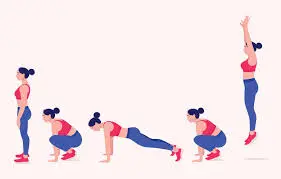
Your feet should be hip-width apart when you begin standing. Reach for the floor. Hop your feet back into a plank while keeping your hands on the ground. (Instead, take a step back to adjust.) Either stay in your plank position or drop your chest to the floor. Step your feet out of your hands or hop. After completing one bodyweight squat or squat leap, go back to the beginning position.
Mountain Climbers:
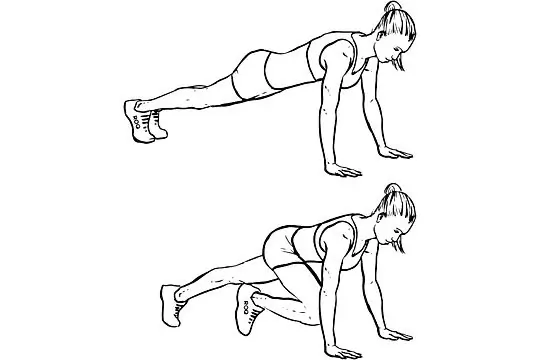
Take a high plank stance to begin. Your spine should remain parallel to the ground. To keep your spine safe, use your core. Alternate legs and drive your knees in toward the middle of your chest.
Pull-ups:
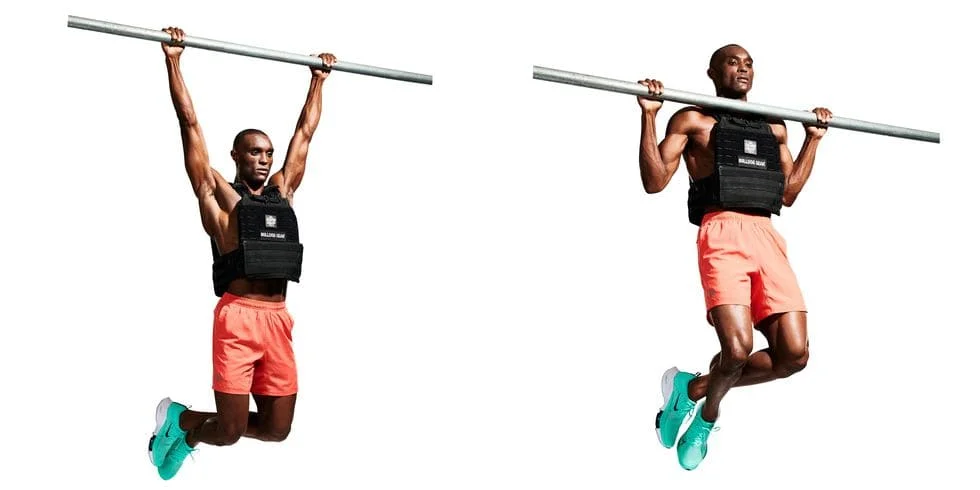
Any workout that incorporates a pulling or rowing motion is considered a pulling activity. Similar to pushing, pulling can be further divided into vertical pulling (like pull-ups) and horizontal pulling (like seated rows).
Anyone who works a desk job has to perform horizontal pulling exercises since they will develop all of the back’s postural muscles and help counteract the rounded, slouched shoulder position that comes with desk labor. It’s a good idea for desk jockeys to incorporate two pulling motions for each pushing motion.
Jumping jacks:
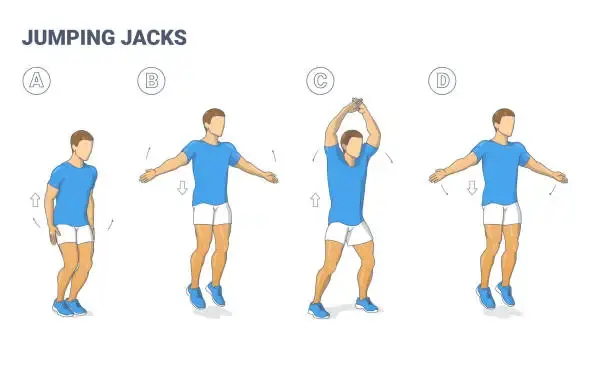
Start with your hands by your sides and your feet together. Raise your arms over your head and out to the sides while simultaneously jumping your feet out to the sides. (Chapin your hands together over your head is one option.) Swing your arms back down and hop your feet back together to get back to the starting position. Instead of jumping, step your feet out to the sides to adjust this workout.
Bicycle crunches:
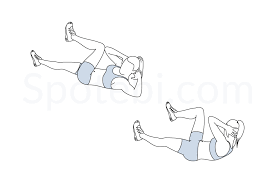
The abdominal muscles, particularly the rectus abdominis and obliques, are the main focus of the very powerful core-strengthening exercise known as the bicycle crunches. In order to simulate a cycle action, you must lie on your back, raise your shoulders off the floor, and alternatively pull one knee toward your chest while rotating your torso to touch the opposing elbow.
Bicycle crunches enhance core stability, balance, and coordination in addition to helping to develop stronger, more defined abs. They minimize the risk of lower back pain, promote improved posture, and increase functional strength by simultaneously using several muscle groups. Bicycle crunches can greatly increase core strength and abdominal endurance when done correctly and with controlled motions.
Walking lunges:
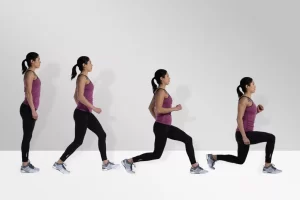
An effective lower-body exercise that works the quadriceps, hamstrings, glutes, and calves, as well as the core for stability and balance, is the walking lunge. Stepping forward into a lunge position, bringing your back knee down toward the floor, and then pushing through your front heel to send your back leg forward into the next step are all part of this dynamic movement.
Walking lunges are great for increasing balance, functional strength, and general lower-body endurance because they constantly test muscle control and coordination, unlike stationary lunges. They promote improved posture, increase hip flexibility, and help build stronger, more toned legs and glutes.
Conclusion:
In summary, adding a range of functional workouts to your regimen aids in increasing flexibility, strength, and general fitness. Exercises that work several muscle groups and improve balance, coordination, and endurance include walking lunges, bicycle crunches, pull-ups, and jumping jacks.
Regular practice with appropriate form enhances long-term health and physical performance in addition to supporting improved posture and injury prevention. A stronger, more stable, and better-conditioned physique can be attained by maintaining consistency and progressively increasing effort.
FAQs:
What are workouts for body conditioning?
Body conditioning is a comprehensive exercise program that emphasizes strengthening and toning the complete body. To increase muscular mass, endurance, and overall fitness, this class usually combines resistance training, bodyweight exercises, and aerobic activities.
Which three strength exercises are the most important?
The squat, bench, and deadlift—the Big 3 of powerlifting—may be the best ways to develop and assess total body strength. However, to increase total body muscle size and enhance overall body composition, these same movements can be incorporated into a greater volume training regimen.
Which three workouts work the entire body?
The foundation of full-body training consists of compound exercises such as presses, deadlifts, and squats. They are highly effective at developing functional strength that is useful in daily life since they engage several muscle groups simultaneously. A three-day regimen is best for novices.
What kind of workout is superior to walking?
Compared to walking, running is a higher-intensity workout that improves cardiovascular fitness and burns more calories in less time. If you want to lose as much weight as possible, running can burn up to three times as many calories per minute as walking.
Which full-body workout is the most effective?
Deadlift to Row: Incorporates a row’s pulling motion into the deadlift, simultaneously working the legs, core, and back. The Farmer’s Walk is a straightforward but efficient workout that uses walking with heavy weights to improve the grip, forearms, shoulders, back, core, and leg muscles.
Which three strength exercises are the most important?
The squat, bench, and deadlift—the Big 3 of powerlifting—may be the best ways to develop and assess total body strength. However, to increase total body muscle size and enhance overall body composition, these same movements can be incorporated into a greater volume training regimen.
Which five strength training exercises are fundamental?
The Squat, Deadlift (Hip Hinge), Overhead Press, Row, and Push-Up are five fundamental strength training exercises that address key movement patterns. Pull-ups and planks are also great options for developing functional strength for the entire body. Focusing on correct technique to safely gain strength, these exercises target major muscle groups, enhance coordination, and may be modified with bodyweight or weights for at-home or gym workouts.
Which ten strengthening exercises are there?
Focus on compound exercises like squats, deadlifts, lunges, push-ups, and overhead presses for a well-rounded strength program. You can also incorporate core exercises like the plank, back exercises like the Bent-Over Row or Superman, and isolation exercises like bicep curls and tricep dips. You can also use bodyweight exercises like pull-ups or glute bridges to effectively target your major muscle groups.
Body strength exercises: what are they?
Your muscles become stronger, bigger, more powerful, and more resilient as a result. The exercises require you to work against resistance or use your own weight. Try to perform two or more muscle-strengthening workouts per week.
A total body strength workout: what is it?
Total Body Strength is a strength and tone-focused, no-equipment program that emphasizes functional fitness. It is intended to assist you in increasing muscle definition, tone, and mass throughout your body. Additionally, it will improve your quality of life by making daily chores much simpler to do and finish.
References:
- Nakpro, S. (2025, March 14). Best Exercises for Full-Body Strength and Conditioning. NAKPRO NUTRITION. https://nakpro.com/blogs/blog/best-exercises-for-full-body-strength-and-conditioning?srsltid=AfmBOooQF_3WQc5_P4BxJ120-HRK3rqgr-NcSpvayvkKrWoYVSJzrRQB
- How to get a Full-Body workout at home without any equipment. (2025, October 28). TODAY.com. https://www.today.com/health/strength-training-exercises-your-home-workout-no-gym-needed-t192702
- Cpt, L. B. (2026, January 29). 9 Total body Exercises (35-Minute strength + steps). Nourish, Move, Love. https://www.nourishmovelove.com/total-body-exercises/
- Lopez, R. (2025, April 30). I’m a Peloton Strength Instructor, and These Are My Favorite Bodyweight Training Moves. https://www.onepeloton.com/blog/bodyweight-exercises
- Cscs, D. P. R. (2024, September 2). Workout routines for men: How to reach your fitness goals. Healthline. https://www.healthline.com/nutrition/workout-routine-for-men